

TL;DR
Contractors who win more bids follow a few habits on every job.
- Bid only on construction projects that fit your trade, capacity, and geographic location.
- Track your bid-hit ratio by project type and build estimates from real job costs.
- Ask questions early, attend pre-bid meetings, and price risk where the owner can see it.
- Send a bid proposal with a detailed scope, clear exclusions, and relevant past projects.
- Use Followup CRM to see your bids, deadlines, and follow-ups in one place.
How GCs and Project Owners Evaluate Bids
Price matters, but it rarely decides a bid on its own. When GCs and project owners compare construction bids, they are also judging how much risk each bidder brings to the job.
The first thing they check is completeness. A low number with missing items or a vague project scope looks like a future change order. A bid with a detailed scope and clear exclusions often reads as the safer choice, even at a slightly higher price.
Next comes confidence in delivery. Evaluators look at your track record on similar construction projects, your proposed schedule, and whether you have the crew to start on time.
On public projects, they also confirm bid bonds, insurance, and licensing. Private owners have more freedom to weigh reputation and past relationships.
Responsiveness counts too. How quickly and clearly you answer questions during the bid window shows the owner how you will communicate once work starts.
Decision makers also weigh value. A contractor who spots a design issue or proposes a cost-saving alternative shows a commitment to project success.
Every strategy below targets one or more of these factors.
How to Win More Construction Bids
The nine strategies below follow the construction bidding process in order, from deciding which jobs to chase to learning from the ones you lose.
Each one fixes a common reason contractors lose winnable work. Used together, they help you submit fewer but stronger bids.
1. Qualify Construction Projects Before Committing Resources
Every bid costs estimating hours, and those hours are limited. Bidding on every invitation spreads your team thin and produces rushed numbers on jobs you were never likely to win.
Smart contractors run a quick bid/no-bid review before committing resources to an estimate. Start with fit. Does the project match your trade and past projects? Does the project's size suit your bonding and crew capacity? Is the site in a geographic location you can serve profitably?
Then check the terms. Look at the schedule, payment terms, and the owner's payment and project history. Watch for red flags such as incomplete project documents, an unrealistic timeline, or unclear site conditions.
If a project fails the review, pass on it. Walking away frees your estimators to produce quality bids on the right projects, and quality bids win more often than volume.
2. Track Your Bid-Hit Ratio by Project Type
Your bid-hit ratio shows how many bids you win compared to how many you submit. To calculate it, divide the number of bids you won by the number you submitted over a set period. If you submitted 20 bids last year and won five projects, your ratio is 25%.
The overall number is only a starting point. Break it down by project type, client, size, and public versus private work. Patterns show up fast.
You might win most of your commercial construction bids under a certain value, or find that certain owners award you work far more often than others.
A segmented bid-hit ratio helps you aim your bidding efforts where they pay off. If one project type wins one bid in three and another wins one in ten, the choice of where to focus is clear.
Then review profitability on the jobs you win. A high win rate on jobs that barely break even usually means you are pricing too low. Put your estimating time into the project types that both win and protect your profit margins.
3. Build Relationships That Bring In Better Construction Jobs
Many good construction jobs never reach an open bid board. They go to contractors the GC or owner already knows and trusts.
Owners and GCs post projects on public bid boards and plan rooms, and those listings are worth watching. Building relationships, however, brings a steadier flow of quality leads and invitations to bid (ITBs), often with fewer competitors.
Start with the decision makers. On any project, find out who reviews the bids and who signs off on the award. Make sure they know your trade, your capacity, and the project types you want.
Pitching to someone with no role in the award wastes both your time and theirs.
Get prequalified with the GCs you want to work for, so you are already approved when their next project opens. Stay in touch with past clients, join local trade associations, and ask satisfied customers for referrals.
Prospective clients also talk to each other. A reputation for finishing on schedule and on budget does more for your next bid than any sales pitch.
4. Clarify the Project Scope Before You Price It
Assumptions are expensive. If you price a vague scope, you either pad the number and lose, or guess low and absorb the difference after you win.
Read every project document before you start the estimate, including specifications, drawings, and addenda. Note anything unclear, then submit requests for information (RFIs) to the architect or GC right away.
Most bid packages set a cutoff date for inquiries, and late questions often go unanswered.
Confirm the special requirements too. Public projects often call for bid bonds, prevailing wage rates, and strict compliance with local regulations. Owners may also require specific material brands or insurance limits.
Attend the pre-bid meeting and site visit whenever you can. Some owners make attendance mandatory, and skipping it means you cannot submit a bid.
On site, check access, staging space, existing conditions, and whether environmental protection measures such as erosion control will be needed.
Every answer you collect tightens your number and gives you a more detailed scope to present in the proposal.
5. Turn Past Job Costs Into a Competitive Advantage
Your own history is the most reliable pricing data you have. Industry averages and old estimates cannot tell you how your crew performs on your type of work.
Contractors who estimate construction jobs the same way every time start with a quantity takeoff, so they know the exact amount of material each job needs. Price that material with current supplier quotes, since material costs shift between bids.
For labor costs, use productivity rates from past projects and price hours at the fully burdened rate, including payroll taxes, insurance, and benefits.
Subcontractor pricing needs the same care. Collect several quotes per trade, and confirm that every sub priced the same scope before you compare numbers.
After each completed job, compare estimated and actual job costs. This comparison helps turn historical cost data into accurate estimates for future work. If certain tasks run over again and again, adjust those assumptions before the next bid.
Over time, this loop sharpens your bid accuracy. Competitors who price from memory cannot match it, and that consistency becomes a real competitive advantage.
6. Price Risk and Contract Terms Where Owners Can See Them
Every bid carries risk factors, including weather, material price swings, labor shortages, and site conditions nobody saw before breaking ground. Ignoring them makes a bid look cheap on paper and expensive in practice.
List the potential risks for the specific job and size your contingency to match. A fast-track schedule or an unfamiliar site deserves a larger buffer than repeat work for a known client. Padding every line item, however, pushes your number out of range.
Where you can, show the risk instead of hiding it. Break out allowances for unknowns such as subsurface conditions, so the owner sees exactly what that money covers. For volatile materials, propose an escalation clause instead of guessing future prices.
Read the contract terms with the same care. Retainage, payment schedules, liquidated damages, and indemnity clauses all affect what the job is really worth. Price them in or list them as qualifications.
Bidding competitively does not mean bidding low. It means submitting accurate bids that owners trust, and that still leave you a healthy margin.
7. Write a Bid Proposal That Sells More Than a Number
A bid proposal is a sales document. When project owners compare several bids, the one that explains its number clearly usually gets a closer look.
Open with a short executive summary written for this specific project. Two or three sentences on the owner's goals and your approach show that you read the documents.
Then spell out the scope. List what is included and, just as clearly, what is excluded. Replace a single lump sum with a cost breakdown by labor, materials, equipment, and major scope items, so reviewers can see where the money goes.
Add proof. A few past projects similar in size and type, with photos and references, say more about your track record than a general company brochure.
Where you see a smarter approach, offer it as a priced alternative. A value engineering option that saves money without cutting scope shows the owner you think like a partner.
Teams that carefully craft each proposal from a consistent proposal structure stop competing on price alone.
8. Keep Your Bidding Process Ahead of Every Deadline
A late bid does not get read, however strong the number is. Missed deadlines are rarely about effort. They happen when due dates live in inboxes, spreadsheets, and one estimator's memory.
Treat every due date like a project milestone. Record each invitation in a shared bid log as soon as it arrives, with the due date, the person responsible for the submission, and any addenda. Keep all due dates on one calendar the whole team can see.
Then work backward from the deadline. Set internal dates for sub quotes, estimate review, and final sign-off, and aim to submit bids a day early. That buffer leaves time to address upload problems, a last-minute addendum, or a missing form.
Any of these issues can sink an otherwise competitive bid.
On public work, a bid that arrives after the deadline is usually rejected outright, so the buffer matters even more.
9. Follow Up and Debrief Losses to Sharpen Your Bid Strategy
Many contractors submit a bid and wait. A short, professional follow-up keeps your proposal in front of the reviewer and gives you a chance to answer questions before the decision.
Confirm receipt on the day you submit. A few days after the bid date, check in to ask whether the reviewer needs any clarification. Keep each message brief and useful.
Having ready-made follow-up emails for bids makes it easier to stay consistent when several bids are open at once.
When you lose, ask why. Many owners and GCs will tell you where your number landed or what tipped the decision if you ask politely.
Log every loss under one main reason: price, scope, qualifications, or relationship. After a few months, the pattern shows where your bid strategy needs work.
Price losses point back to estimating. Scope losses point to clarification and proposal gaps. Relationship losses point to business development.
Review your wins the same way. Knowing why you won helps you repeat it on the next bid.
No More Scattered Bid Management With Followup CRM
Every strategy in this guide depends on visibility. You cannot track a bid-hit ratio, hit every deadline, or follow up on time when bid details sit in inboxes and spreadsheets.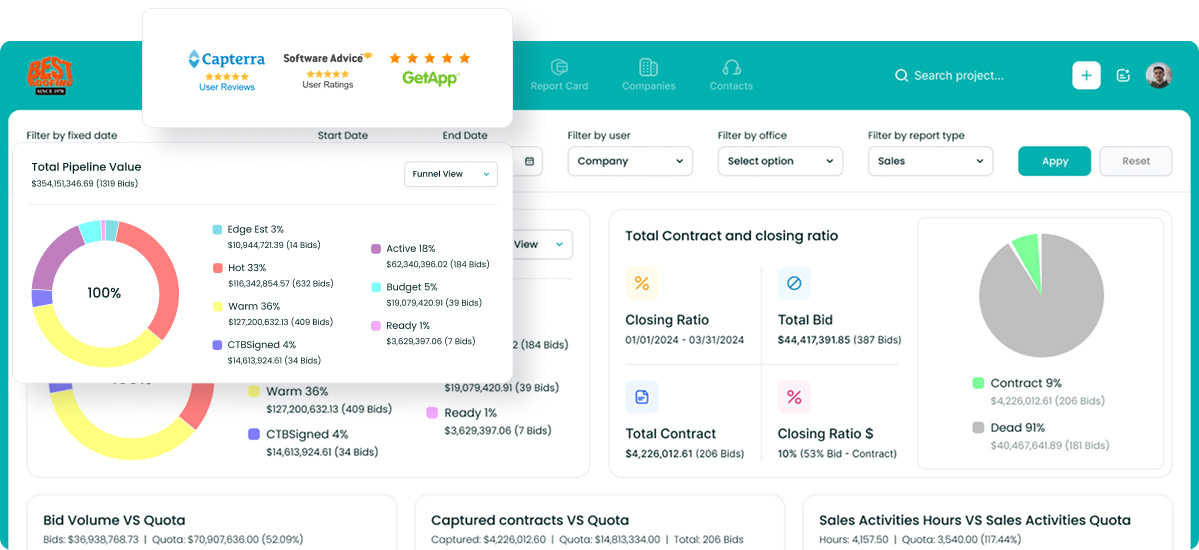
Followup CRM is a construction CRM built for commercial and specialty trade contractors, covering the sales cycle from first lead to award.
Leads from multiple sources land in one pipeline, and each bid's details, documents, and status stay tied to the right contact and project. The digital bid calendar puts every due date on one shared view, and reminders keep follow-ups on schedule after submission.
When it is time to check in, Gregg AI Assist drafts follow-up emails and notes from the record you are working in. Pick the Follow-Up Reminder prompt, choose a tone, and edit the draft before you send it.
Voice AI turns a spoken recap of a call or site visit into CRM entries, so updates get logged while details are fresh.
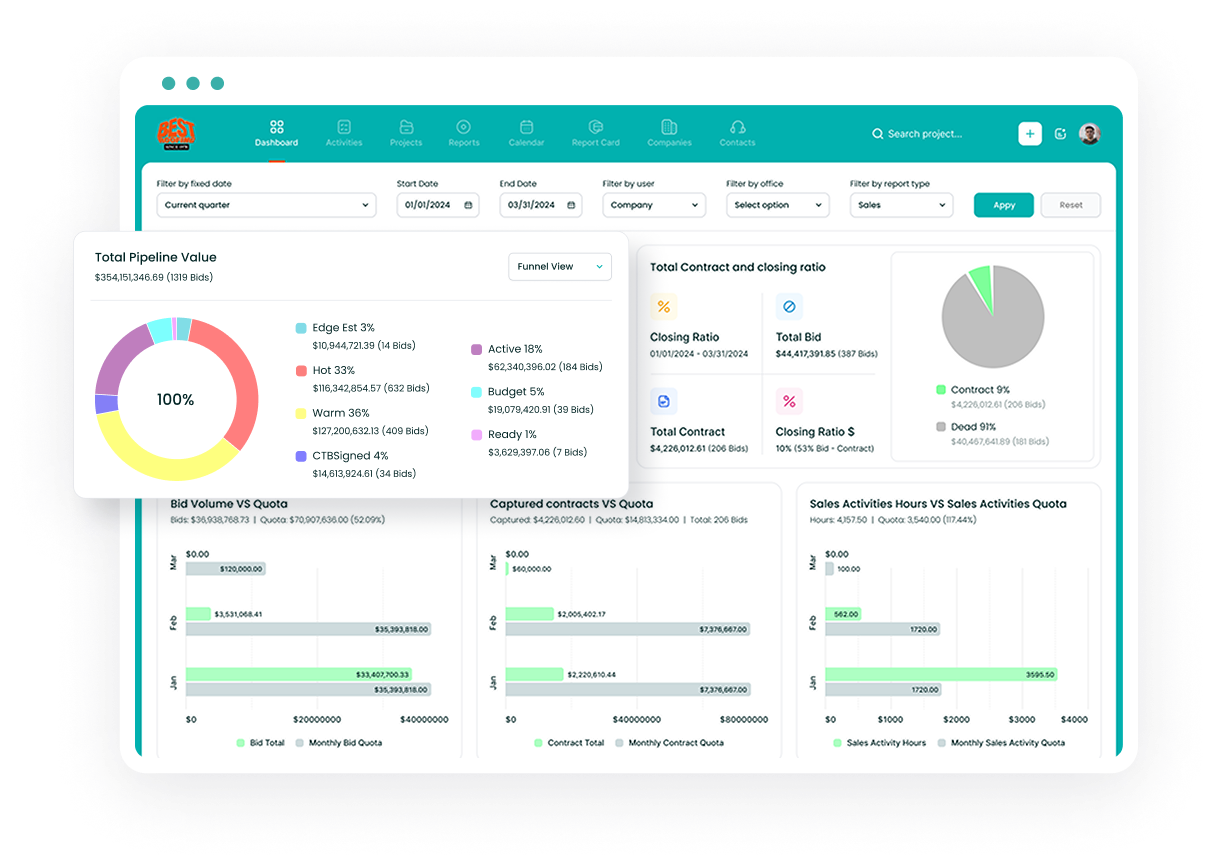
The Proposal Generator builds branded proposals with e-signature. Win and loss reports and real-time dashboards show your bid-hit ratio and which projects you win or lose, so you know where your team's time pays off.
Followup CRM provides construction bidding software for the sales side of bid management and connects with tools like Procore, Sage, Foundation, QuickBooks, and Outlook.
Book a demo to see how your team can track, follow up on, and win more of the projects you pursue.
FAQs About How to Win More Construction Bids
What are the most common bidding strategies?
The most common approaches are selective bidding, low-price bidding, value-based bidding, and negotiated work. Selective bidding puts estimating time only into projects that match your trade, capacity, and win history.
Low-price bidding competes mainly on cost and holds up only when your costs are genuinely lower. Value-based bidding wins on scope clarity, schedule, and priced alternates. Negotiated work comes from GCs and owners who already trust you.
Most contractors mix these by project type. Followup CRM's win and loss reports show which bids you win and lose, so you can judge which approach is paying off.
What are the key factors for a contractor to win a public construction bid?
Price leads, but only among bids that qualify. In federal sealed bidding, the contract goes to the responsible bidder with the lowest responsive bid.
A responsive bid follows the invitation in every material respect, so a missing bid bond, an unsigned form, or a late submission can disqualify the lowest number.
A responsible bidder is one that can perform the work, judged on factors such as financial resources, capacity, and performance record.
State and local agencies set their own rules, and some award on best value instead. Read each solicitation closely, and keep every due date on a shared bid calendar like the one in Followup CRM.
What are common bidding mistakes to avoid?
The most common mistakes are bidding on every invitation, pricing from memory instead of job cost data, and sending a lump-sum number with no scope or exclusions. Missed deadlines and silence after submission also cost contractors winnable work.
Ignoring losses is the quieter mistake, because the same errors repeat unnoticed. Followup CRM keeps deadlines, follow-ups, and win and loss records in one place, so these gaps are easier to spot.
The CRM Built For Construction Companies
No more disorganized data. Track your leads, bids, and customers all in one place.
Seamless Integration with:
✅ Foundation ✅ Viewpoint ✅ Sage and more