


TL;DR
- To estimate construction jobs accurately, review the bid documents and site conditions, complete a quantity takeoff, price materials and labor, add equipment and subcontractor costs, then apply overhead and profit before submitting the proposal.
- Separate direct costs (e.g., materials, labor, equipment, and subcontractors) from indirect costs such as insurance, office expenses, software, and administrative salaries.
- Use current supplier quotes and your own historical productivity data instead of copying old estimates or relying on memory; labor should be calculated at the fully burdened rate, not just the base wage.
- Protect your margin by accounting for material waste, site conditions, scope gaps, overhead, and deliberate profit. Clearly document inclusions, exclusions, and qualifications in the final proposal.
- Followup CRM helps contractors manage what happens around the estimate by tracking bid deadlines, proposals, follow-ups, close rates, and historical results, helping turn better bid data into smarter future estimates.
Overview of a Construction Estimate
A construction estimate is a detailed forecast of what a project will cost to build. It covers every expense from the first delivery of construction materials to final cleanup, and it forms the basis of the bid you submit to the client.
A strong estimate protects your margin. A weak one either loses the job or wins it at a price that hurts the construction business.
Cost estimates fall into two broad categories:
- Direct costs: Expenses tied to the physical work itself. This includes material, labor, equipment, and subcontractor costs for the specific job.
- Indirect costs: Expenses that keep the company running but do not attach to a single task on site. Think office rent, general liability insurance, estimating software, and administrative salaries.
Estimates also vary in precision. A preliminary estimate gives the client a rough range early in the conversation, often based on similar past projects.
A detailed estimate comes later, built from a full quantity takeoff and current pricing. Most contractors move through both stages, and the final bid should always rest on the detailed version.
Understanding this structure matters because accurate estimates account for every category. Miss one, and the gap comes straight out of profit.
How Software Improves Construction Estimating
Spreadsheets can hold an estimate, but they cannot manage the process around it. The right tools connect estimating to everything before and after it, and that connection is where accuracy compounds.
Construction estimating software handles the takeoff and pricing work. Construction management software runs the job after the award. The gap between them is the sales side: tracking which bids are due, which proposals went out, and which follow-ups are overdue.
That is where a construction CRM fits, and it is where most contractors leak revenue without noticing. Followup CRM is built for exactly this stage.
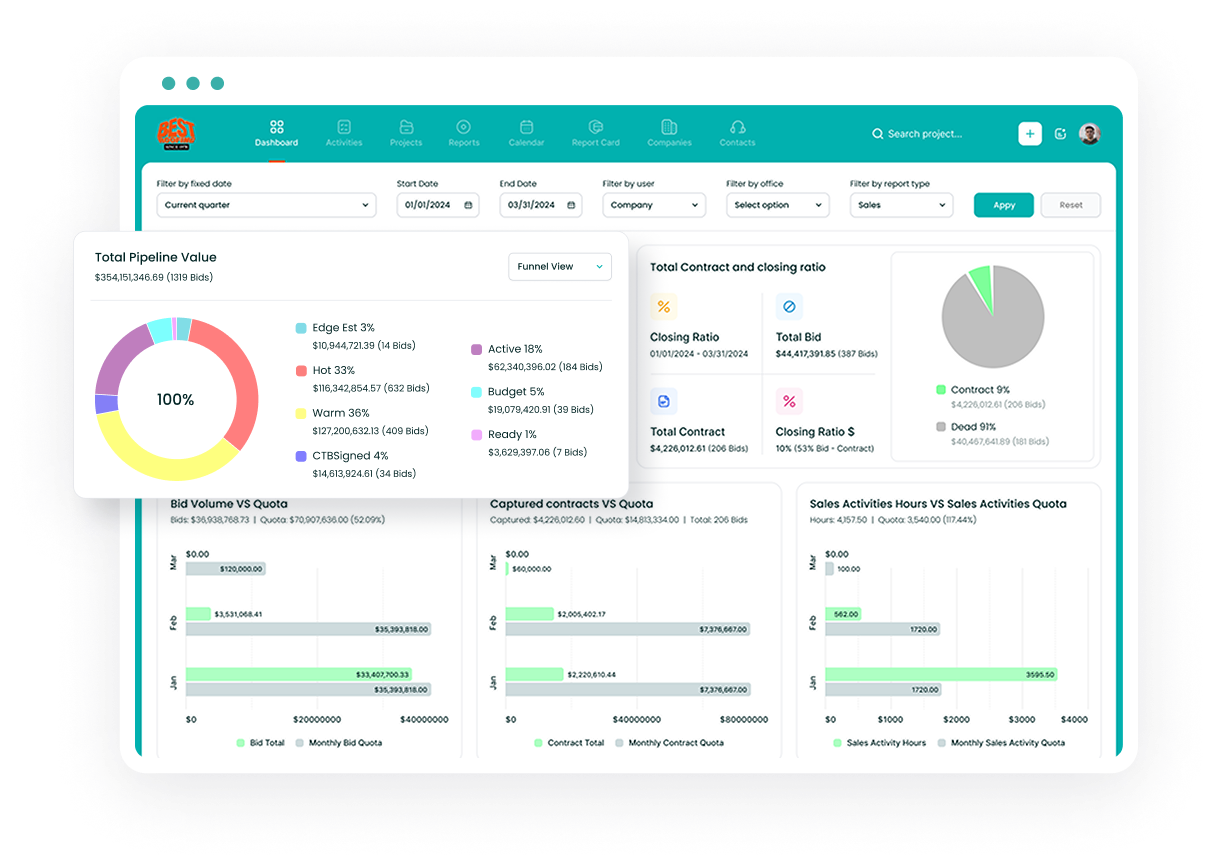
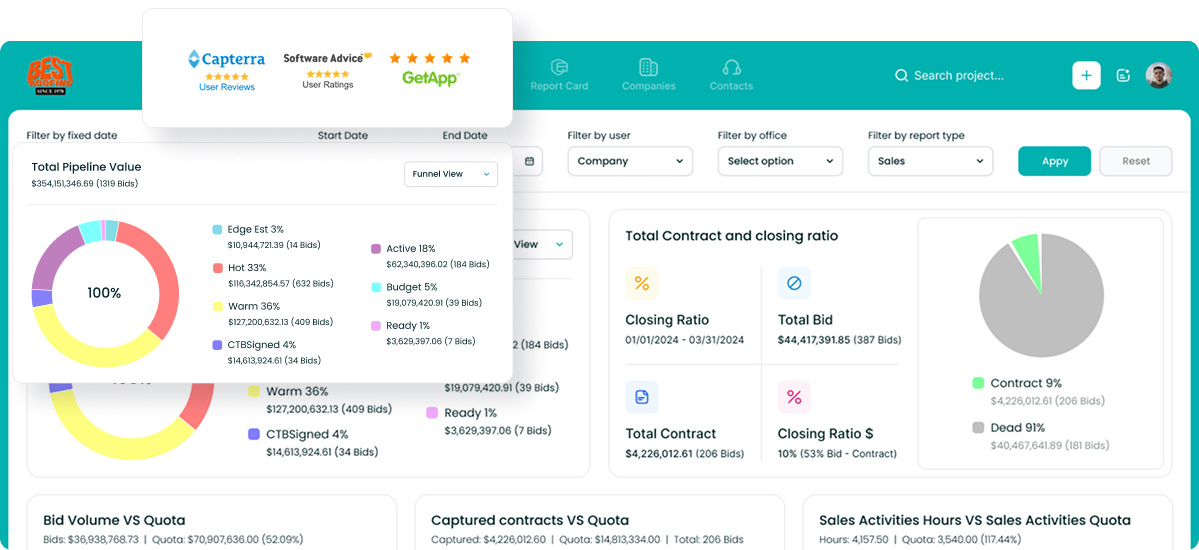
It gives commercial and specialty trade contractors a digital bid calendar so no due date slips, a proposal generator with e-signature so estimates turn into professional proposals in minutes, and sales dashboards that show close rates and team performance in real time.
That historical data feeds directly back into estimating. When you can see which jobs you win and how estimated numbers compare to job costing results, every future bid gets smarter.
For contractors running Procore, the integration makes the handoff clean. Followup CRM manages leads, bids, and proposals. The project pushes to the Procore Bid Board for estimating, and the estimate fields sync back to Followup CRM automatically.
When the bid is won, the project moves to Procore with contacts and documents intact, with no re-entry.
See Your Whole Bid Pipeline With Followup CRM
An accurate estimate deserves a sales process that matches it.
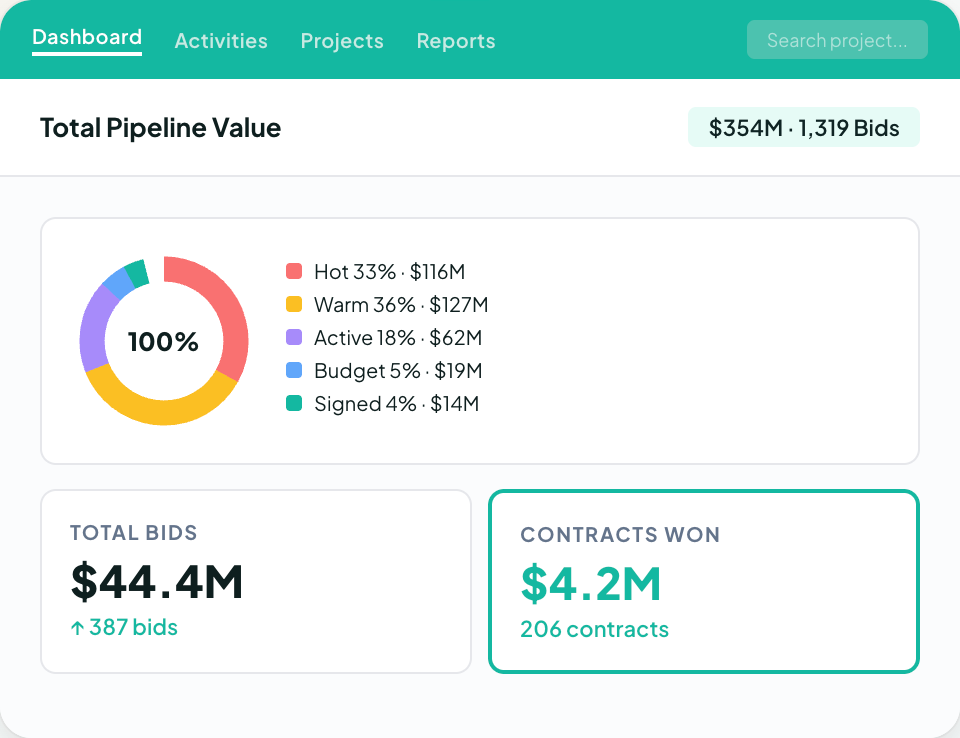
Followup CRM keeps every lead, bid, and proposal in one place, so you always know what is due, what went out, and what needs a follow-up call today.
Followup CRM helps track bids on a shared digital bid calendar, build branded proposals with e-signature, and turn win-and-loss history into better numbers for the next estimate.
You can watch the pipeline update in real time and see how the Procore integration moves an awarded project straight into project management with no re-entry.
Book a demo with Followup CRM today.
How to Estimate Construction Jobs: A Step-by-Step Guide
The estimating process below applies to nearly every trade, from roofing and electrical to concrete and flooring. Work through the steps in order, and the estimate builds itself layer by layer.
1. Review the Bid Documents
Start by reviewing bid documents in full. That means the drawings, specifications, addenda, and contract terms. The goal is a strong understanding of the project scope before a single number gets written down.
Note anything unusual, such as tight completion dates, special material requirements, or penalty clauses.
Pay attention to what the construction documents leave out. Gaps in the drawings become change orders later, but only if you catch them and qualify your bid accordingly. Write down every question and get answers from the general contractor or owner before pricing begins.
Most estimators who skip this step end up pricing assumptions instead of facts, and assumptions are where margins go to die.
2. Visit the Job Site
Plans never tell the whole story. A site visit reveals conditions that directly affect project costs. Look for access restrictions, limited staging areas, poor drainage, existing structures, and utility locations. On renovation work, check the condition of what you are building on or around.
Document everything with photos and notes. Site conditions discovered after work begins are one of the most common causes of cost overruns, and the contract may not cover them if you had a chance to inspect first.
A one-hour walk of the construction site can save weeks of unpaid work.
3. Complete the Quantity Takeoff
The material takeoff is where estimating gets granular. Using the drawings, measure and count all materials required for the job. Lumber in board feet, concrete in cubic yards, wire in linear feet, fixtures by unit.
Modern takeoff tools speed this up, but the principle stays the same regardless of method.
Apply a waste factor to each material category. Cuts, breakage, and ordering minimums mean you always buy more than the drawings show. Typical waste factors run from a few percent on simple materials to significantly more on complex cuts. Base yours on past jobs, not guesswork.
4. Price Your Materials
With quantities in hand, attach current prices. Material prices move constantly, so use supplier quotes rather than figures from the last estimate. For a project that starts months out, ask suppliers how long quotes stay valid and factor in pricing trends for volatile materials.
Where possible, lock in prices with purchase orders once the job is won. If prices cannot be locked, build an allowance or escalation clause into the bid. Small adjustments at this stage protect the margin far better than absorbing a mid-project price spike.
5. Calculate Labor Costs
Labor is usually the largest and least predictable cost category. Start with labor requirements: which trades the job needs and how many hours each phase will take. Estimate labor hours using productivity rates from your own past projects.
If your crew installs a known quantity of material per day, history tells you how many hours the current project demands.
Then price those hours at the fully burdened rate, not the base wage. The burdened rate includes payroll taxes, workers' compensation, benefits, and paid time off.
The gap between base wage and burdened cost is significant, and estimating from the base wage alone quietly erases profit on every job.
6. Add Equipment and Subcontractor Costs
Equipment costs cover everything from owned machinery to short-term rentals. For owned equipment, charge the job an hourly or daily internal rate that reflects fuel, maintenance, and depreciation.
For rentals, get current quotes and include delivery, pickup, and operator costs where they apply.
Subcontractor costs need the same rigor as your own numbers. Collect at least two or three quotes per trade, and double-check that each sub priced the same scope. A low quote that excludes half the work is not a low quote.
Also account for temporary facilities the job requires, such as site offices, fencing, sanitation, and temporary power.
7. Apply Overhead and Profit
Now calculate overhead. Indirect costs like office rent, insurance, vehicles, software, and administrative staff must be recovered on every estimate. Total your annual overhead and spread it as a percentage of expected annual revenue, then apply that percentage to the job.
Profit comes last, and it is a separate line, not something buried in padded numbers. Profit margins vary by trade, market conditions, and risk. Competitive markets compress margins while specialized work supports higher ones.
Whatever the number, set it deliberately. A bid without deliberate profit is a donation.
8. Build and Submit the Proposal
The estimate becomes a proposal, and presentation matters. A clear, professional proposal that spells out scope, inclusions, exclusions, and payment terms wins more work than a bare number in an email. Include qualifications for anything the bid documents left ambiguous.
Send it on time and then follow up. A surprising share of bids die from silence, not price. Track submission dates, follow-up touches, and outcomes for every project estimate so nothing gets lost between bid day and the award decision.
Common Estimating Mistakes to Avoid
Even experienced estimators lose money to a handful of repeat mistakes. Watch for the following:
- Relying on memory rather than records: Gut feeling is not data. Compare estimated numbers with actual costs from completed jobs, and use that history to make future estimates more accurate.
- Copying old estimates: No two jobs match. A particular project may look like the last one and still hide different site conditions, specs, or market pricing. Reuse the process, not the numbers.
- Skipping the site visit: Photos and drawings miss the conditions that cause budget overruns. Walk the site whenever access allows.
- Ignoring scope gaps: Anything the drawings leave vague should be qualified in writing. Silence becomes free work.
- Math and transcription slips: Estimating is a complex process with hundreds of line items, and human error creeps in through manual entry. Have a second person review the totals, or better, let the software do the math.
- Underpricing to win: A thin bid feels like momentum until the job starts. An accurate cost estimate that loses politely beats a bad one that wins.
The fix for most of these is the same. More detail, better records, and a system that catches what memory misses.
FAQs About How to Estimate Construction Jobs
Can ChatGPT do construction estimates?
Not reliably. General AI tools can explain estimating concepts and help draft proposal language, but they have no access to your local labor rates, current supplier pricing, or the project drawings. Estimating construction costs with generic numbers is a guess.
Use AI for support tasks and keep the actual takeoff and pricing in a purpose-built process, with every bid tracked in a system like Followup CRM.
How do I quote a construction job?
Review the bid documents, walk the site, complete a quantity takeoff, then price materials, labor, equipment, and subcontractors. Add overhead and profit, then present the total in a written proposal that defines scope, exclusions, and payment terms.
The quote is only half the work. Follow up consistently after submission, since many bids are lost to silence rather than price.
What is the best app for construction cost estimating jobs?
It depends on the trade and the size of the work, since takeoff and pricing tools are built around specific workflows. What matters just as much is what happens around the estimate.
Followup CRM connects the construction estimating process to the rest of the sales process with bid tracking, proposal generation, and e-signature, and it integrates with Procore, so awarded projects move into project management without re-entry.
How do you estimate new construction costs?
New construction follows the same steps as any other work, with one advantage. There are no hidden existing conditions to price around, so the drawings carry more of the answer.
Start with a preliminary estimate based on cost per square foot from similar past projects, then build the detailed estimate from a full takeoff once final drawings are ready.
The CRM Built For Construction Companies
No more disorganized data. Track your leads, bids, and customers all in one place.
Seamless Integration with:
✅ Foundation ✅ Viewpoint ✅ Sage and more