

TL;DR
Here are the seven best roofing contractor tools in 2026.
- Followup CRM
- AccuLynx
- JobNimbus
- Roofr
- RoofSnap
- ServiceTitan
- Jobber
What Is a Roofing Contractor Tool?
A roofing contractor tool is any platform built to handle the daily work of running a roofing company. That includes:
- Tracking leads and bids
- Scheduling jobs
- Measuring roofs
- Sending professional estimates
- Managing job costs
- Keeping the office and the job site on the same page
Most roofing companies end up using more than one tool. A sales and bid tracking CRM handles the front end of the business, while measurement, scheduling, or accounting software covers the rest.
Some platforms try to do everything in one place, while others focus on a single task and do it well.
The tools below cover both camps. Some are built for commercial roofing contractors managing long bid cycles. Others fit small roofing businesses that live and die by fast residential quotes. Match the tool to how your company actually wins work, not to the longest feature list.
Top 7 Roofing Contractor Tools for 2026
Each entry below is a standalone review. You'll see what the software does, who it fits, and the key features that matter for roofing work.
Followup CRM leads the list for sales and bid tracking, and the rest cover measurement, residential quoting, scheduling, and field service work. Pick based on the lane your roofing company competes in.
1. Followup CRM
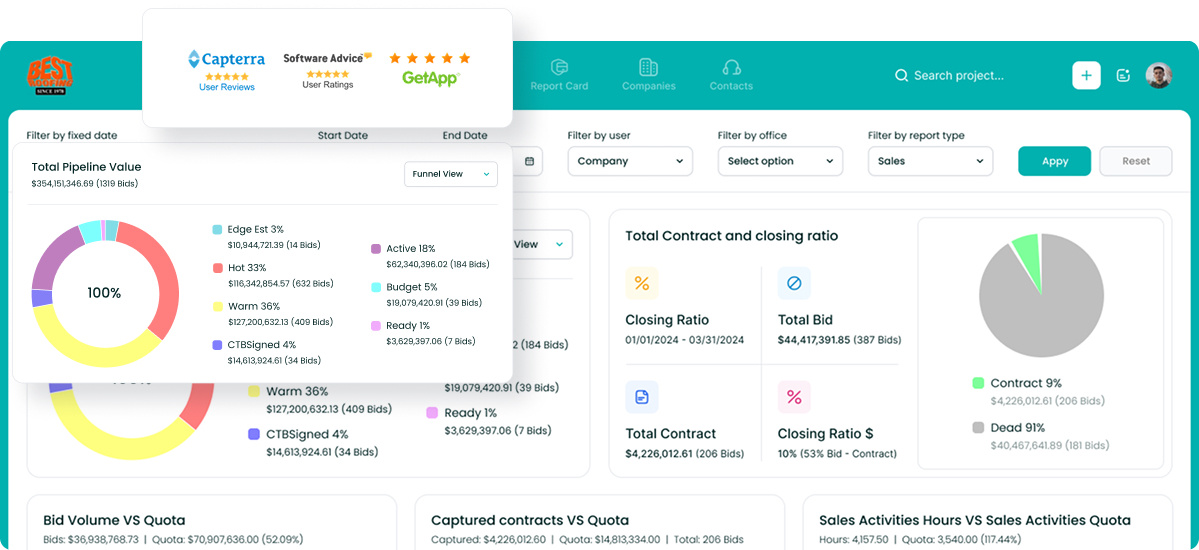
Followup CRM is a sales and bid tracking CRM built specifically for commercial and specialty trade contractors, and roofing is where it started.
The platform tracks the full sales cycle from lead intake through bid, proposal, and close. A digital bid calendar keeps the entire team on top of due dates, which matters when your revenue depends on bidding.
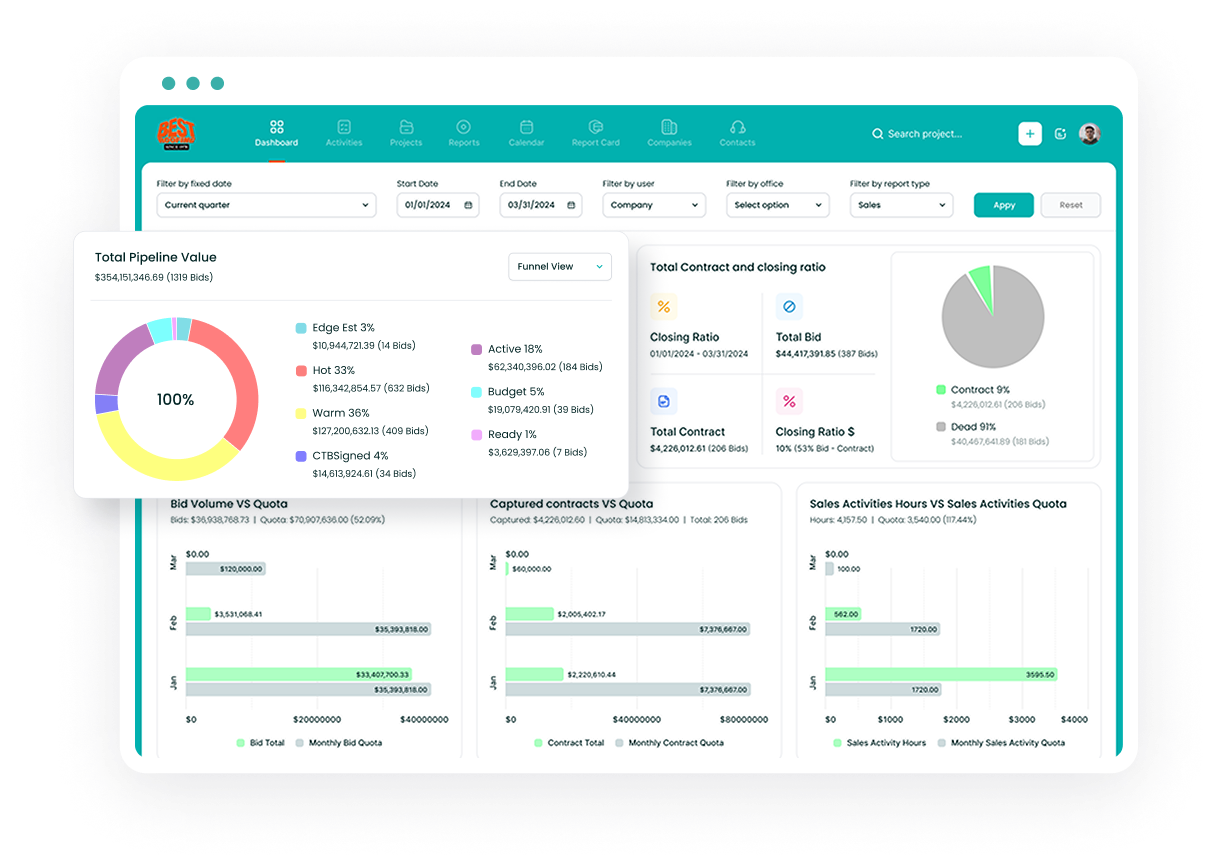
Sales dashboards show pipeline, close rates, and rep performance in real time, so leadership can see exactly where jobs are won and lost.
Key Features:
- Lead and bid tracking with a shared digital bid calendar.
- Proposal generator with e-signature.
- Sales and estimating dashboards for pipeline and close-rate visibility.
- Gregg AI Assist for drafting comments and emails inside the CRM.
- Outlook and Gmail integration that auto-logs email activity.
- ERP integrations with Foundation, Vista, Spectrum, Sage, and QuickBooks.
Best Roofing itself grew from $6M to $60M running its sales process on this system. For roofing contractors who win work through bids, Followup CRM is the strongest option on this list.
Book a demo now and learn how Followup CRM can elevate your roofing business.
2. AccuLynx
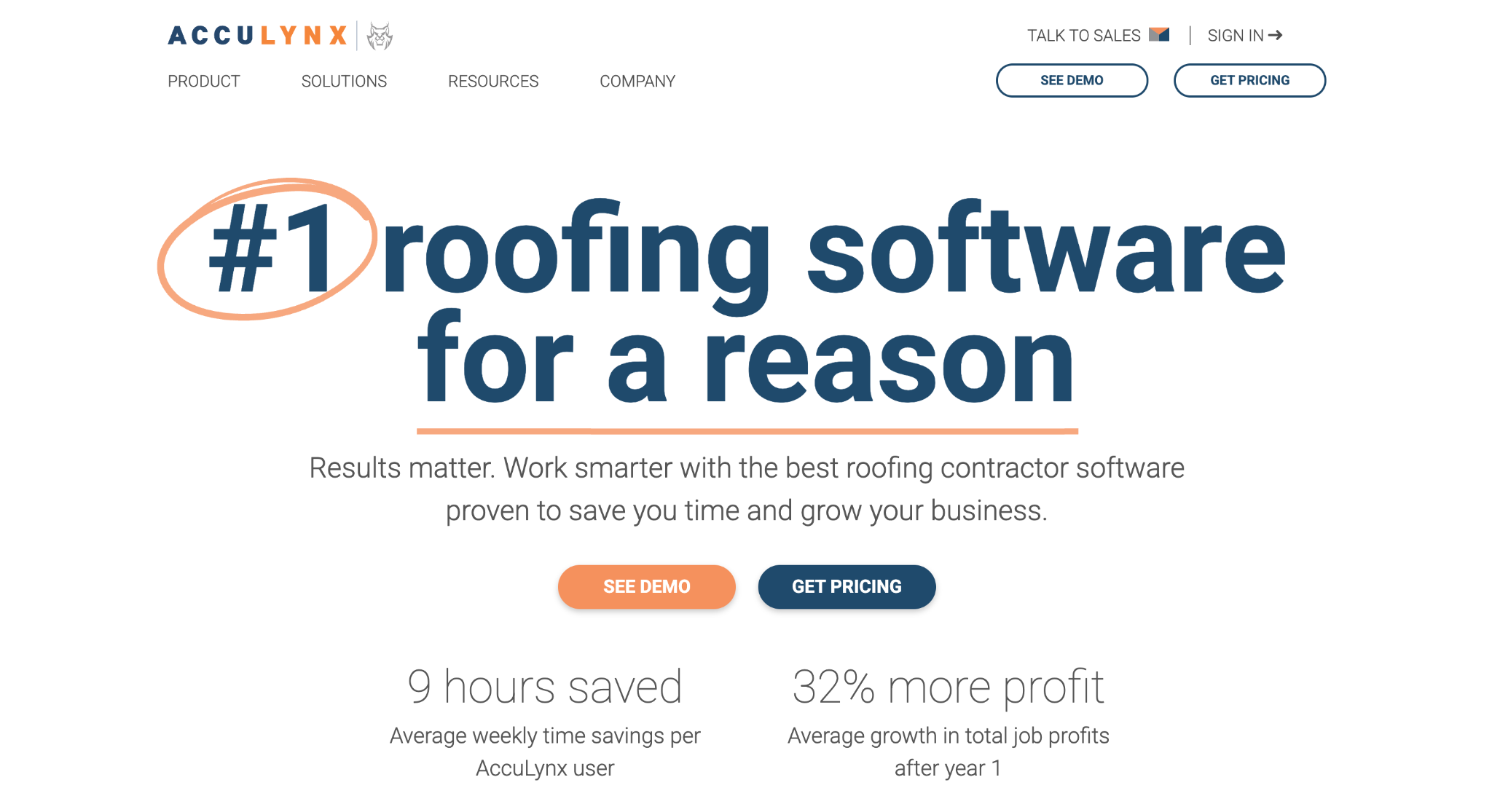
Image source: acculynx.com
AccuLynx is an all-in-one management platform for residential roofing companies. It covers the job lifecycle from sales pipeline through production, material orders, and payment, which makes it a good fit for roofing contractors who want the office and field crews working from one system.
Its supplier integrations stand out. AccuLynx connects directly to ABC Supply, SRS Distribution, and QXO, so users can check real-time material pricing and availability by branch, then place material orders without leaving the platform.
That removes the phone calls and double entry that usually sit between a signed job and an order at the supply house.
Key Features:
- Direct material ordering through ABC Supply, SRS Distribution, and QXO.
- Real-time supplier pricing and stock visibility by branch.
- Aerial measurement integrations, including EagleView and GAF QuickMeasure.
- Sales pipeline and job management in one system.
- Mobile crew app for field teams.
AccuLynx is suitable for established residential roofing companies that order materials constantly and want procurement tied to the same platform that runs their jobs.
3. JobNimbus
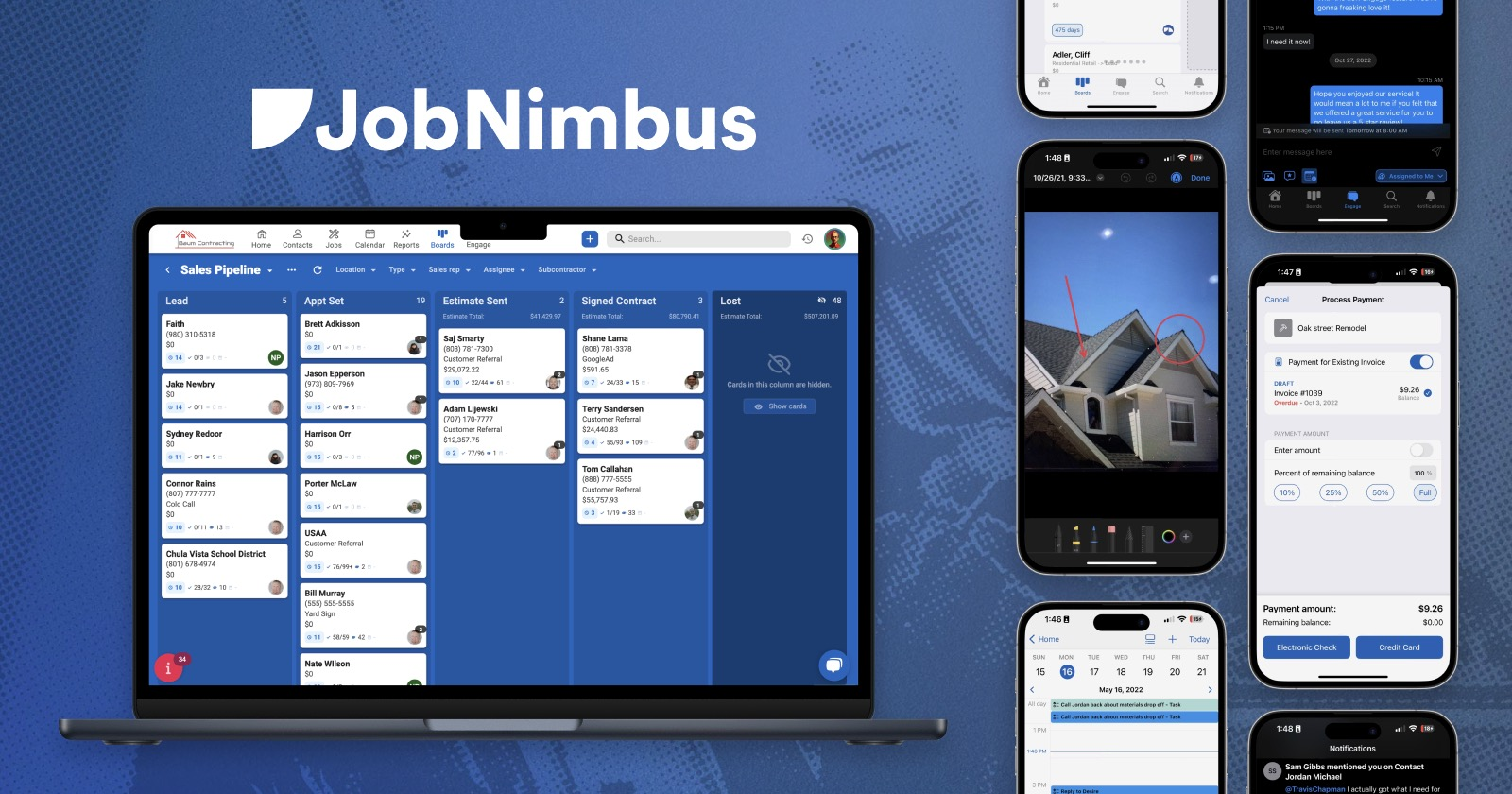
Image source: jobnimbus.com
JobNimbus is a roofing CRM and project management app aimed at residential and insurance restoration work. Jobs move through visual boards that map to each stage of the sales process, and automations handle routine steps, such as moving a job to Sold once a proposal is signed.
Photo documentation is built into the job record. Crews handle photo capture on site, annotate images directly in the app, and turn them into photo reports for customers or insurance claims. That is useful for storm work, where documenting damage decides whether a claim gets paid.
Key Features:
- Visual job boards with custom sales workflows.
- Photo capture, annotation, and photo reports from the mobile app.
- Aerial measurement ordering attached to the job folder.
- Material orders sent from estimates with supplier integrations.
- Integrated financing so customers can apply for rate quotes from the job record.
- Text messaging with a shared inbox.
JobNimbus is a good fit for residential roofing businesses that run on photos, insurance claims, and a stage-by-stage pipeline.
4. Roofr
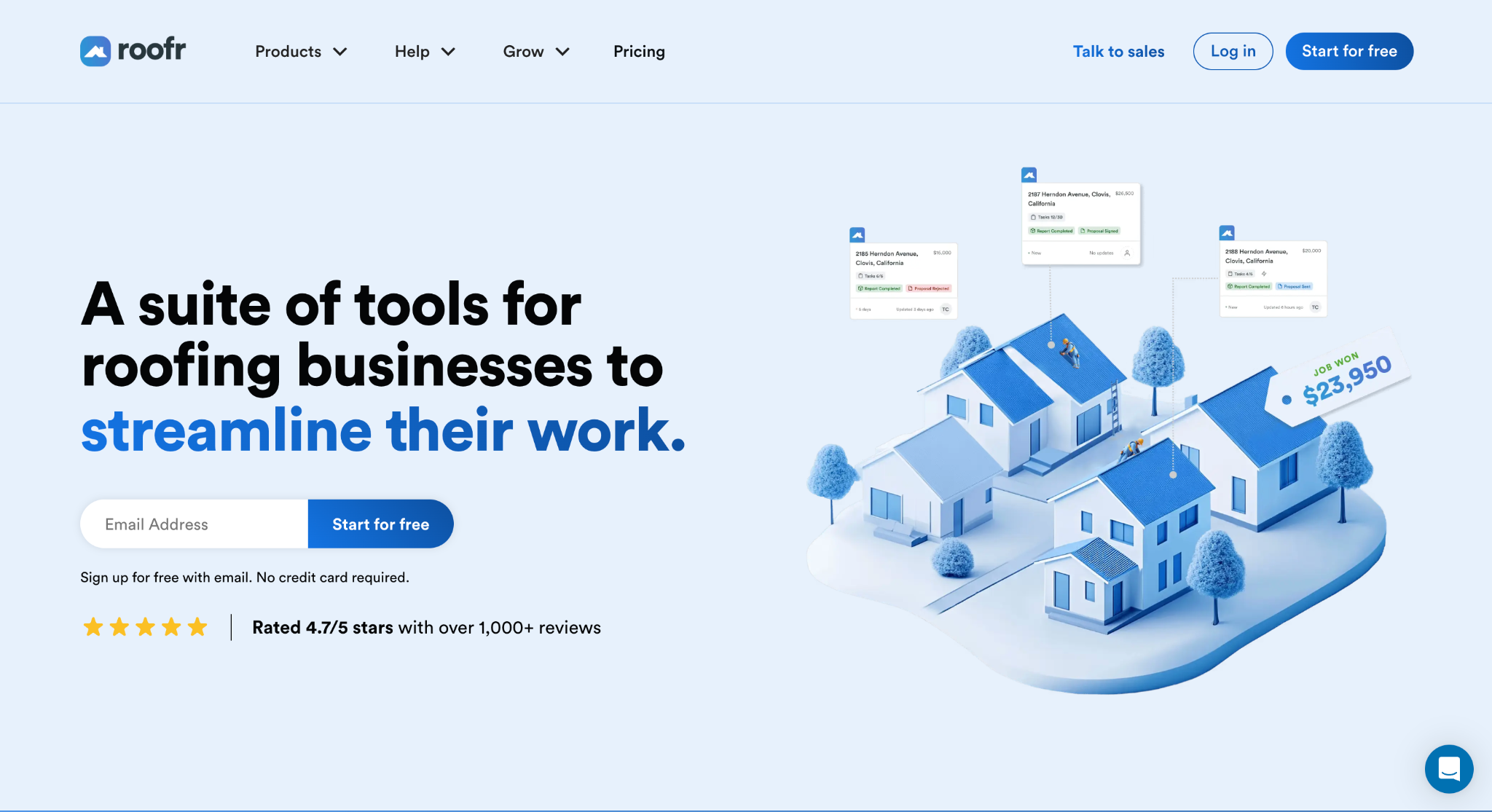
Image source: roofr.com
Roofr is a sales-focused platform for residential roofing companies, built around roof measurement reports and proposals.
Users order a measurement report for a flat fee and get it back in as little as two hours on paid plans, or draw the measurements themselves with the built-in tool. Each report covers the structures at the address, material calculations, and a recommended waste factor.
From there, a report converts into a customizable proposal with e-signature support, so a rep can go from address to signed deal without a site visit for measuring.
An instant estimator widget also lets homeowners generate quotes from the contractor's own pricing, feeding new leads straight into the job board.
Key Features:
- Roof measurement reports with fast turnaround, plus a draw-it-yourself option.
- Customizable proposals with e-signatures.
- Instant estimator for homeowner-facing quotes.
- Material ordering from signed proposals.
- Invoicing and online payments, which help roofers get paid faster.
- Job boards and automations for pipeline tracking.
Roofr is a good fit for small and midsize roofing businesses that want measurements, professional estimates, and proposals handled in one place.
5. RoofSnap
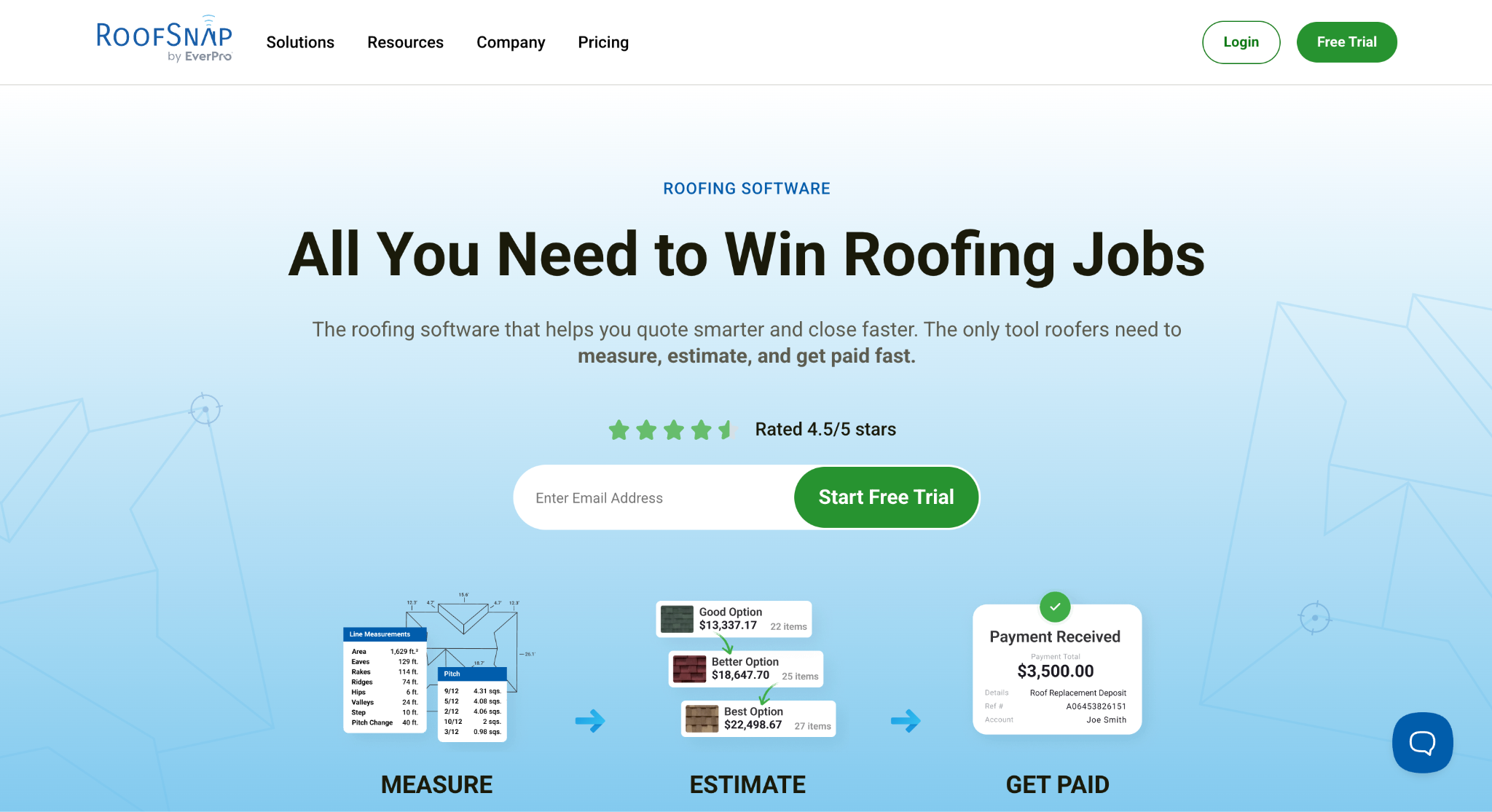
Image source: roofsnap.com
RoofSnap is measuring and estimating software for roofing contractors, along with a roof measurement service. It leans on high-resolution aerial and satellite imagery, so users get accurate measurements of roof area, pitch, and edge lengths without a ladder or a site visit.
There are two ways to measure. Contractors can trace the roof themselves on the imagery, which RoofSnap states lands within a 1 to 3% margin of error when drawn correctly, or order a report and have trained technicians handle it.
Standard orders come back within two to four hours, and rush orders in 30 minutes or less during business hours.
Key Features:
- Roof measurements from aerial and satellite imagery.
- On-demand measurement reports with fast and accurate turnaround.
- Estimate builder with Good, Better, Best templates.
- E-signable contracts and documents.
- Material orders sent to suppliers.
- Mobile app for iOS and Android, useful for sales reps working on site.
RoofSnap is suitable for roofing crews that mainly need fast measurements and accurate estimates rather than a full management platform.
6. ServiceTitan
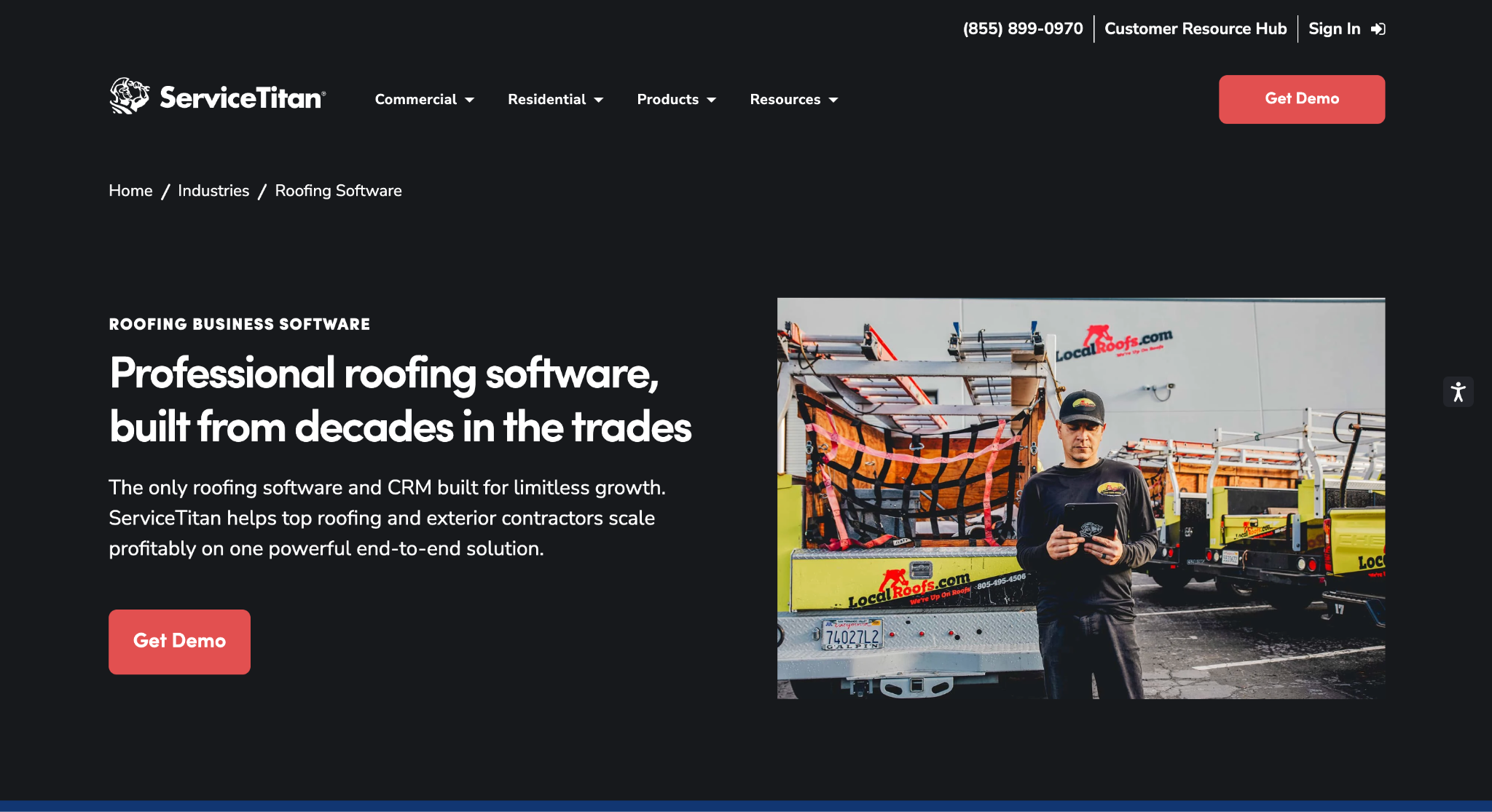
Image source: servicetitan.com
ServiceTitan is field service management software with a dedicated product for roofing companies. It aims at larger residential operations that need the whole business, from call booking through dispatch and payment, running on a single platform.
The software tracks and records customer calls, handles job scheduling and tech dispatching, and moves work through estimating, material orders, and payment processing. Time tracking is built in, and the mobile app gives roofers job details in the field on both iOS and Android.
Key Features:
- Call tracking and recording tied to customer records.
- Job scheduling and dispatching for multiple crews.
- Estimating, material orders, and payment processing in one system.
- Time tracking for field teams.
- Mobile app for iOS and Android.
- Automation and reporting for the back office.
ServiceTitan is suitable for established roofing companies with high call volume and dedicated office staff, where scheduling, dispatch, and cash flow all need to run through one system. Smaller operations may find it more platform than they need.
7. Jobber
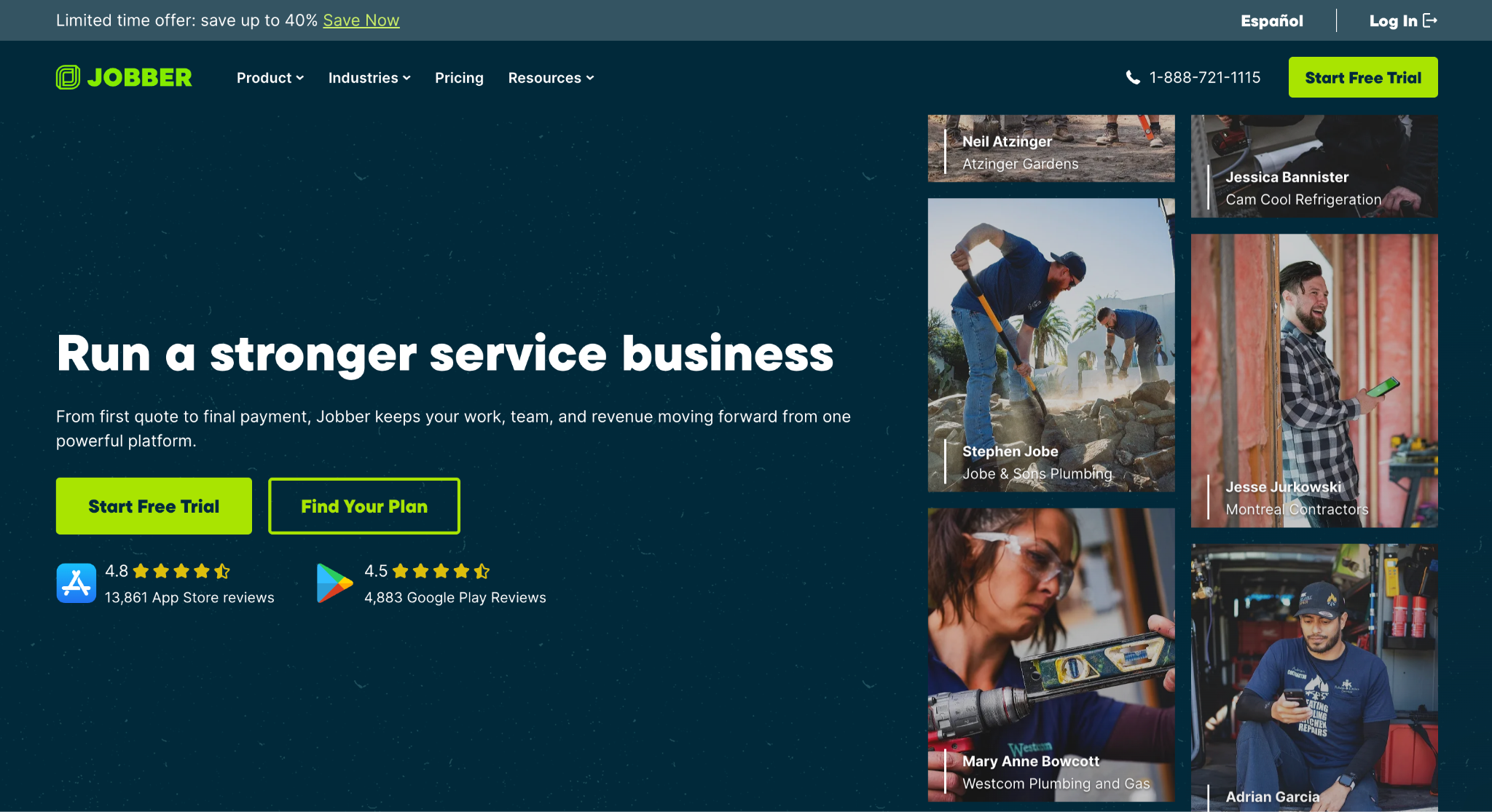
Image source: getjobber.com
Jobber is field service software used by many trades, with a setup aimed at roofing contractors. It covers the basics of running a small service business, including quoting, job scheduling, invoicing, and client management, all from a mobile app.
Quotes can include photos from the on-site assessment, and customers approve them online, pay a deposit, or sign from their phone. A self-serve client hub lets homeowners check scheduled work and pay invoices without calling the office.
Automated reminders follow up on quotes and appointments by text or email, so leads don't slip while the crew is on a roof.
Key Features:
- Professional quotes with online approval, deposits, and signatures.
- Job scheduling with drag-and-drop changes and crew notifications.
- Automated reminders for quotes, appointments, and invoices.
- Client hub for self-serve approvals and payments.
- EagleView integration for aerial roof measurements.
- QuickBooks integration for accounting.
Jobber is a good fit for a small crew doing residential roofing work that wants scheduling and quoting handled cleanly without a heavy platform.
How to Choose the Right Roofing Contractor Platform
The right pick depends on how your company wins work and what breaks down day to day. Different types of roofing software solve different problems, so judge each tool against the criteria below before signing anything.
Match the Tool to Your Lane
A commercial contractor running long bid cycles needs bid tracking and pipeline visibility. A residential company doing storm work needs photos and claims support.
Most roofing companies get in trouble by buying software built for a different part of the roofing industry than the one they compete in.
Check Measurement Accuracy
Fast, accurate measurements determine whether your estimates hold up. Look at where the imagery comes from, how current it is, and what the stated margin of error looks like for the roof types you actually bid.
Look at Integrations
Your software should connect to the accounting, scheduling, and project management software you already run. Every gap between systems means manual re-entry, and every time, there is a chance for an error.
The goal is one single dashboard where job data lives once.
Dig Into Job Costing
Knowing whether a job made money is the whole game. Check how the tool handles job costing and job financials, and whether it supports cost codes if your accounting setup depends on them.
Ask About Field Crew Features
Crews on the roof have different needs than the office. Depending on your work, that can mean GPS-verified clock-ins for labor tracking, certified payroll support for prevailing wage jobs, or offline functionality for job sites with weak signal.
Confirm these directly with the vendor before buying.
Weigh Onboarding and Support
Software only pays off if the entire team actually uses it. Ask whether the vendor provides dedicated onboarding, how much dedicated time setup requires, and what support looks like after launch.
A tool that saves time on paper but never gets adopted saves nothing.
Win Bids With a Clear Sales Process Using Followup CRM
Spreadsheets and whiteboards don't scale. Deadlines slip, follow-ups get forgotten, and nobody knows which bids are worth chasing. Running a successful roofing company means knowing exactly where every lead, bid, and proposal stands.
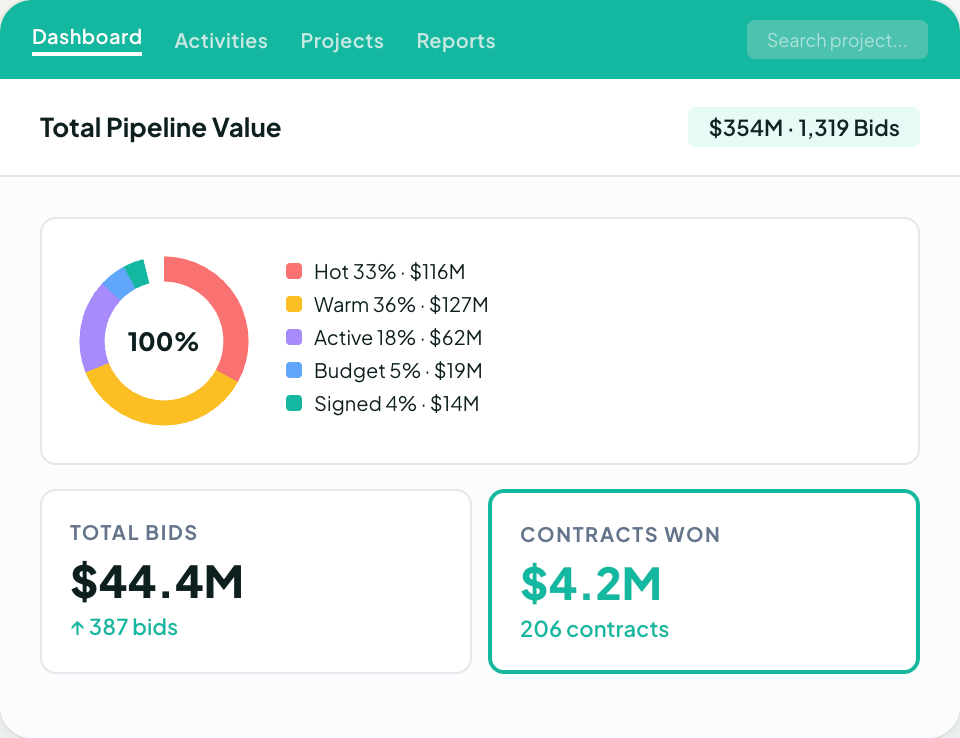
Followup CRM was born from that exact problem. In 2009, Gregg Wallick, owner of Best Roofing, went looking for software that fit how a specialty contractor sells and found nothing on the market. So he built his own bid tracking system in-house.
Running on that system, Best Roofing grew from $6M to $60M, and the software became Followup CRM, now trusted by over 1,000 construction professionals.
That same system can run your sales process. Track every bid on a shared calendar, send proposals with e-signatures, and watch your close rates in real time, so your team works smarter and wins more jobs.
Request a live demo of Followup CRM and see how it fits your roofing business.
FAQs About Roofing Contractor Management Software
What is the 25% rule for roofing?
The 25% rule comes from the Florida Building Code. If more than 25% of a roof's total area or a roof section gets repaired, replaced, or recovered within a 12-month period, the entire roof system or section must be brought up to the current code, not just the damaged part.
Senate Bill 4-D, passed in May 2022, added a major exception. If the existing roof was built or replaced in compliance with the 2007 Florida Building Code or a later edition, which generally means it was permitted after March 1, 2009, only the repaired portion needs to meet current code.
Roofing contractors working on storm damage in Florida need to track repair scope carefully, and software with solid job tracking, such as Followup CRM, helps keep that documentation in one place.
What is the best CRM for roofing contractors?
Followup CRM is the strongest choice for roofing contractors focused on sales and bid tracking. It was originally built inside a roofing company, Best Roofing, and tracks the full cycle from lead intake through bid, proposal, and close.
The digital bid calendar, proposal generator with e-signature, and sales dashboards fit how roofing companies actually win work.
How much does roofing software cost?
Pricing models vary by tool type. Measurement services usually charge per report, field service platforms typically charge monthly per user, and CRM platforms often use quote-based tiers priced on features and team size.
Followup CRM uses quote-based pricing with three tiers, and the best way to get an accurate number for your team is to book a demo and request a quote.
What are the best apps for roofers?
It depends on the job the app needs to do. For tracking leads, bids, and proposals, Followup CRM is the best option on this list. For measurements, photo documentation, or field scheduling, tools like the others covered above each handle a specific lane.
Most roofing companies pair a sales CRM with one or two specialized apps rather than forcing one tool to do everything.
Do small roofing businesses need management software?
Yes, and the earlier the better. Most roofing companies start on spreadsheets, but the best roofing companies put management software in place before growth exposes the cracks.
The right tools help a small crew scale without adding office staff, since job tracking, scheduling, and client management run on a single platform instead of living in someone's head.
For the sales side, Followup CRM works for small roofing businesses from day one, and its quote-based tiers mean you add features like ERP integration as the roofing business grows.
The CRM Built For Construction Companies
No more disorganized data. Track your leads, bids, and customers all in one place.
Seamless Integration with:
✅ Foundation ✅ Viewpoint ✅ Sage and more


.png)