User Experience and Interface
Spectrum offers a more modern, web-based interface that prioritizes ease of use. Its customizable dashboard provides one-click access to frequently used features, and most users get up to speed quickly.
Vista is more powerful but presents a steeper learning curve. The interface feels dated compared to modern SaaS tools, and initial navigation can be challenging. That said, once mastered, Vista's extensive customization options and grid-based layouts provide efficient workflows for experienced users who need that depth.
Cloud Capabilities
Spectrum is a true SaaS platform — accessible from any internet connection, no local installation required. This matters more than people realize until they're trying to access data remotely or recover from an unexpected disruption.
Vista has evolved significantly through its Viewpoint One platform, offering both browser-based access and HTTPS-connected Windows clients. Its cloud capabilities are now robust, though its roots in on-premise deployment mean some features still work best in specific environments.
Core Functionality
Accounting and Financial Management
Both platforms are built around accounting, but with different strengths.
Vista offers highly customizable accounting workflows, a robust back-end that supports deep data extraction, and strong connections to third-party financial tools. It's built for complexity.
Spectrum delivers streamlined accounting processes with real-time financial data updates and a split-screen layout that speeds up data entry. It's built for efficiency.
Project Management
Vista has historically had the edge here, with mature tools for managing complex projects involving multiple stakeholders and extensive documentation. It excels when projects are large and layered.
Spectrum's project management capabilities have improved significantly with its integration into the Viewpoint Team software ecosystem, making it a stronger option for mid-sized contractors than it used to be.
Implementation
Spectrum implementations tend to go more smoothly, with most users reporting adequate training and support. The web-based architecture simplifies deployment, though custom report creation can be a sticking point.
Vista implementations are more involved. Expect more upfront configuration, and consider budgeting for professional consulting services during setup. The payoff is a highly configured system — but it takes time to get there.
Cost Considerations
Both represent significant investments. Spectrum has moved to a subscription-based model that offers predictable budgeting. Vista has similarly transitioned toward subscription pricing through Viewpoint One, but the total cost of ownership often includes meaningful customization and consulting fees on top of licensing.
Integration Capabilities
Vista connects via SQL and supports a wide range of data export formats. Its maturity means it has established connections with many construction industry tools — including CRM platforms, estimating software, and financial systems.
Spectrum offers strong API-based integrations with modern business applications and works particularly well with Accubid and other construction-specific software.
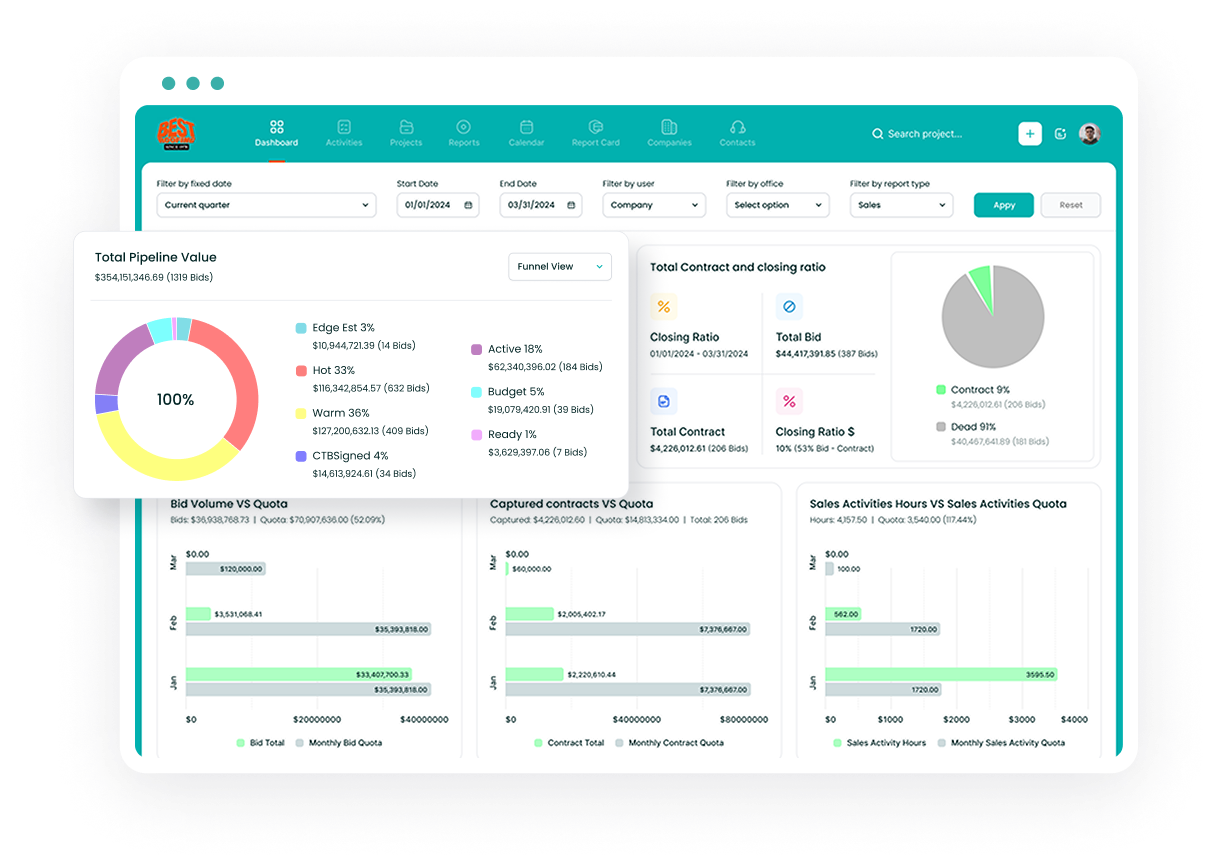
Both Vista and Spectrum integrate directly with Followup CRM, which handles the sales pipeline side that neither ERP is built for — bid tracking, follow-ups, and business development activity from first contact through awarded contract.
Reporting and Analytics
Spectrum has user-friendly reporting tools for creating custom reports, though advanced customization requires knowledge of Crystal Reports.
Vista provides powerful reporting with extensive customization options and supports data extraction for external analysis tools. Some users find the interface less intuitive than modern alternatives, but the depth is hard to match.
Which One Is Right for You?
Vista tends to be the better fit if you need:
- Extensive customization for complex workflows
- Mature project management tools for large, multi-stakeholder projects
- Deep reporting and data extraction capabilities
- Dedicated IT resources to manage the system
Spectrum is often the stronger choice if you want:
- A modern, web-based interface that's faster to learn
- Easier deployment with less IT overhead
- Predictable subscription pricing
- Strong out-of-the-box integrations with modern tools
Both continue to evolve as part of Trimble's construction technology portfolio. The best choice depends on your company's size, operational complexity, and how much configuration you're willing to invest in upfront.
Pair Either Platform with a Construction CRM
Whether you're already running Vista or Spectrum, or planning to implement one soon, there's one gap both platforms share: neither is built for sales pipeline management. That's where a dedicated construction CRM fills the gap.
Followup CRM is a certified Trimble Marketplace partner with direct integrations for both Vista and Spectrum. It connects your business development activity directly to the accounting data you're already tracking — so your sales team and operations team are always working from the same picture.
Citations: [1] https://www.softwareadvice.com/construction/viewpoint-spectrum-profile/reviews/ [2] https://www.softwareadvice.com/construction/viewpoint-vista-profile/reviews/ [3] https://www.joinsecret.com/viewpoint-vista/reviews [4] https://www.capterra.com/p/175831/Spectrum/reviews/ [5] https://www.softwareadvice.com/construction/viewpoint-spectrum-profile/vs/viewpoint-vista/ [6] https://www.trustradius.com/compare-products/viewpoint-spectrum-vs-vista-by-viewpoint [7] https://sites.google.com/trimble.com/vista-cloud-faq/home/moving-to-the-cloud/viewpoint-one-cloud-model-saas-iaas [8] https://www.softwareadvice.com/construction/viewpoint-vista-profile/ [9] https://softwareconnect.com/reviews/viewpoint-spectrum/ [10] https://www.softwareadvice.com/construction/viewpoint-spectrum-profile/