


TL;DR
- AI in construction covers technologies like machine learning, computer vision, and natural language processing applied to real jobsite problems.
- The most proven use cases include estimating and takeoffs, sales and bid tracking, scheduling, progress monitoring, and safety.
- AI also supports predictive maintenance, quality control, document processing, supply chain management, and energy efficiency.
- Contractors get the best results by starting with one bottleneck, piloting a single workflow, and choosing AI tools that connect with their existing software.
- Followup CRM brings AI directly into construction sales with Gregg AI Assist for writing/content and Voice AI for hands-free data entry.
What Is AI in Construction?
AI in construction is the use of artificial intelligence to plan, manage, and execute construction projects with less manual work and better decision-making.
Instead of relying only on experience and intuition, construction professionals use AI systems to analyze data from bids, schedules, jobsites, and equipment, then act on what the data shows.
Several core technologies power these tools. Machine learning algorithms study historical data from past projects to identify patterns and predict outcomes, such as which bids are most likely to win or where project delays are likely to appear.
Computer vision lets software interpret photos and video from construction sites, which makes automated progress tracking and safety monitoring possible.
Natural language processing reads and extracts information from construction documents like contracts, RFIs, and submittals. Predictive analytics ties these together to forecast costs, timelines, and risks before they become problems.
Many of these systems run on deep learning, an approach built on artificial neural networks that can make sense of messy inputs like job-site photos and scanned drawings.
Adoption has been slower in the construction sector than in other industries, partly because every project involves many stakeholders and moving parts. That is changing.
AI tools no longer require a data science team to operate. Most of the examples below come built into software that construction teams already understand, from estimating platforms to CRMs.
12 Examples of AI in the Construction Industry
The examples below cover the full project lifecycle, from winning the bid to maintaining the finished building.
Some are already standard practice at large construction companies, while others are just becoming accessible to smaller contractors. Each one solves a specific, expensive problem, and each is backed by tools you can evaluate today.
1. AI-Powered Estimating and Takeoffs
Estimating is the use case with the clearest measurable results so far. AI takeoff tools use machine learning to read construction plans and automatically detect, measure, and count elements like walls, doors, rooms, and symbols.
What used to take an estimator days of clicking through drawings now takes a fraction of that time.
The numbers back this up. A University of Kansas study found that Togal.ai delivered up to 76% time savings on takeoffs compared to traditional on-screen takeoff methods.
STACK offers similar functionality with its STACK Assist tool, which automatically measures floor plan items so estimators can focus on pricing strategy instead of counting.
The value goes beyond speed. Faster takeoffs mean estimators can respond to more bid invitations, which directly increases the number of construction projects a contractor can pursue.
Accuracy improves, too, since AI algorithms apply the same logic to every sheet instead of getting tired on page forty of a drawing set.
2. AI in Construction Sales and Bid Tracking
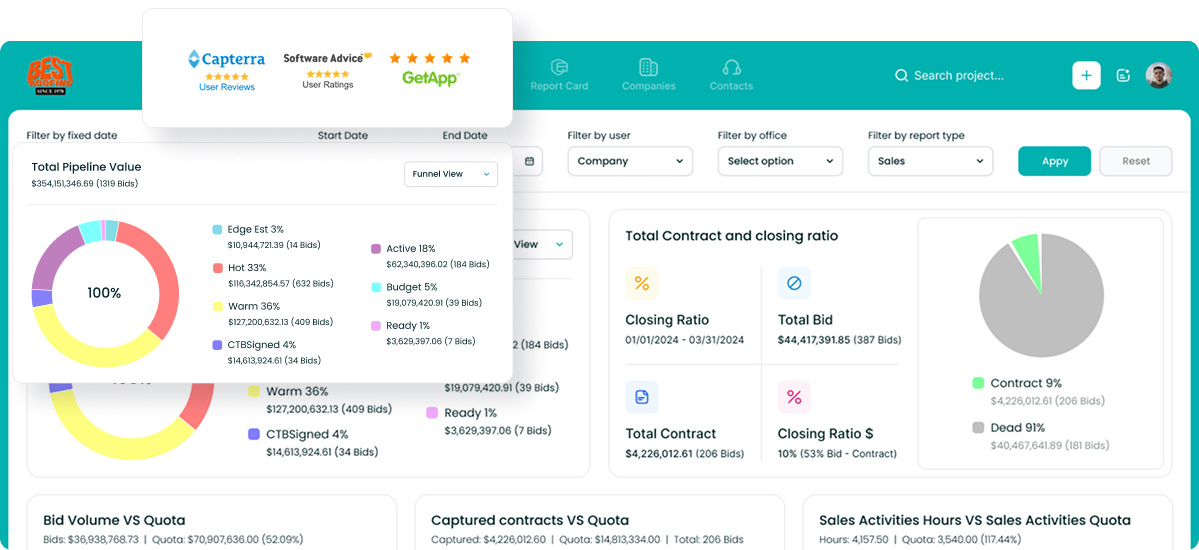
Winning work is just as important as building it, and this is where AI helps before ground ever breaks. Followup CRM, a construction CRM powered by AI, applies it to the sales side of the business that spreadsheets and generic CRMs handle poorly.
Its built-in assistant, Gregg AI Assist, generates first drafts of follow-up emails, task updates, and project summaries directly inside the records a salesperson already works with.
Users pick the content type and tone, review the draft, and send it themselves, which keeps a person in control of every client touchpoint.
Voice AI takes this further by letting contractors speak about what happened after a site visit or client call while the AI handles the data entry into the pipeline.
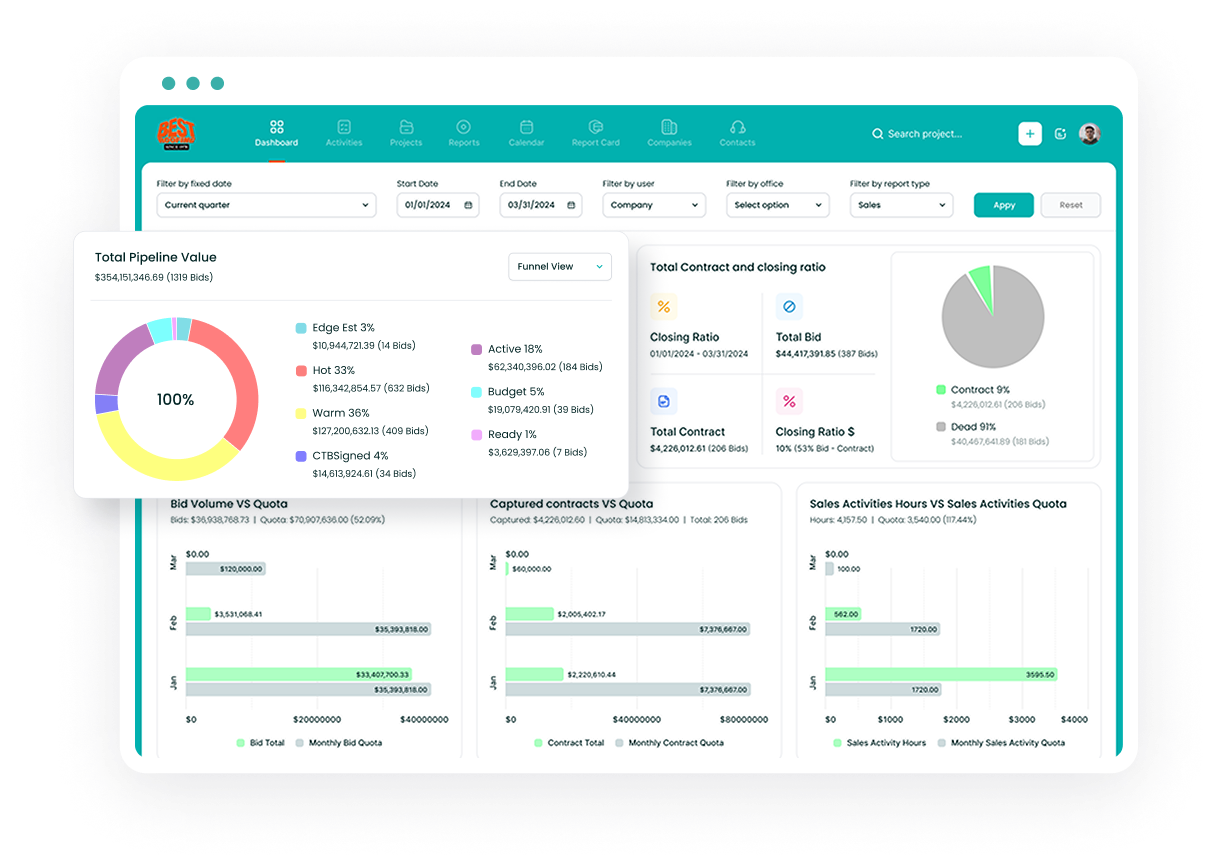
Beyond the AI features, Followup CRM tracks every lead and bid from first contact through close, keeps bid deadlines visible on a shared digital bid calendar, and turns team activity into real-time dashboards showing pipeline health and close rates.
For construction companies that still track bids in spreadsheets, this category of AI often delivers the fastest payback because it directly affects revenue instead of costs.
3. Generative Scheduling and Resource Allocation
Scheduling might be the most computationally demanding problem in construction, which makes it a natural fit for AI.
Traditional methods map one critical path and hope it holds. Generative scheduling tools simulate thousands or even millions of possible schedules, then surface the options that best balance duration, labor, and equipment costs.
ALICE Technologies pioneered this approach. Project teams upload their existing schedule, define constraints like crew sizes and equipment availability, and let the AI optimize resource allocation by exploring sequencing options no human planner would have time to test.
The case study results are concrete. Suffolk Construction used ALICE on a life sciences project to recover 42 days after procurement delays threatened a critical milestone.
On an interstate highway project, a general contractor used the platform to recover time lost to project delays and reported savings of more than $25 million.
Other tools attack scheduling risk from a different angle. nPlan trains its models on a massive dataset of historical construction schedules to forecast which activities are most likely to slip. Instead of optimizing the plan, it warns project managers where the plan is fragile.
Both approaches turn scheduling and resource allocation from a one-time planning exercise into something teams continuously improve.
4. Jobsite Progress Tracking
Knowing what has actually been built, versus what the schedule says should be built, has always required someone walking the site with a clipboard. AI progress tracking replaces that with cameras and computer vision.
Buildots is the clearest example. Site personnel wear 360-degree cameras on their hard hats during routine walks, and the software compares the captured imagery against the BIM model and the schedule to determine which tasks are complete, in progress, or falling behind.
On projects with the Swedish contractor NCC, Buildots reduced manual progress reporting work by 70%, giving project managers time back and much faster visibility into delays.
OpenSpace works on a similar principle, combining 360-degree site capture with computer vision so teams can track progress remotely and document site conditions over time.
The photographic record also settles disputes among project stakeholders, since there is a timestamped visual history of the entire construction process.
The common thread is how these tools enhance project management with speed of truth.
When construction managers monitor construction sites through automated capture instead of weekly walkthroughs, problems surface in days instead of weeks, while there is still time to fix them cheaply.
5. AI-Powered Safety Monitoring
Construction remains one of the most dangerous industries, and most incidents trace back to hazards that someone could have spotted earlier. AI-powered safety monitoring puts a tireless observer on the job.
These systems run computer vision models on feeds from fixed site cameras, drones, and vehicle dashcams.
The software is trained on thousands of labeled jobsite images, so it can distinguish construction workers wearing hard hats and vests from those who are not.
It can also detect when someone enters a restricted zone and flag potential safety hazards like an open excavation without barriers.
When the system spots a violation, it alerts supervisors in real time instead of leaving the issue for the next scheduled inspection.
The more advanced systems go beyond object detection. They analyze interactions between people and equipment, such as a worker's path crossing a crane's swing radius, and predict collisions before they happen.
Every event gets logged automatically, which gives safety managers pattern data they never had before. If one crew repeatedly triggers PPE alerts on night shifts, that is a training conversation backed by evidence.
None of this replaces safety personnel or written safety protocols. It gives them continuous coverage no human team could match, and lets them spend their time correcting behavior instead of hunting for it.
6. Predictive Maintenance for Equipment
Heavy equipment breaking down mid-pour or mid-lift is expensive twice, once in repairs and again in the schedule slip that follows. Predictive maintenance uses AI to catch failures before they happen.
The approach relies on sensors that stream data on vibration, temperature, fluid pressure, and usage hours from machines in the field.
Through continuous data analysis, machine learning models learn what normal operation looks like for each machine, then flag deviations that signal developing problems, like a hydraulic system trending toward failure weeks before it fails.
Caterpillar builds this into its equipment through the Cat Product Link system, which collects operational data and uses AI to predict maintenance needs so owners can schedule repairs during planned downtime instead of reacting to breakdowns.
Industry analyses suggest predictive maintenance programs can cut equipment downtime meaningfully and lower maintenance costs compared to fixed service intervals, though exact results depend on fleet size and how consistently teams act on the alerts.
There is a safety dividend, too. A large share of serious struck-by incidents on construction sites involve heavy machinery, and equipment kept in verified working order removes mechanical failure from the list of ways a jobsite can go wrong.
7. Generative Design and BIM
Design and project planning decisions made before construction starts lock in most of a project's cost, which is why AI's move into design work matters so much downstream.
Generative design tools take project requirements like square footage, structural loads, and budget targets, then produce and evaluate many design options instead of one.
Autodesk has been at the forefront of this. Its research collaboration with Daisy AI produced an end-to-end generative workflow for timber structures, where the AI optimizes timber floor layouts and the conceptual design of mass timber buildings.
Architects and engineers review the generated options and apply their judgment, so the technology widens the option set rather than replacing the designer.
AI also strengthens building information modeling (BIM) itself. Machine learning algorithms scan federated models to detect clashes between structural elements, mechanical runs, and electrical systems before those conflicts become rework on site.
Catching a duct routed through a beam in the model costs nothing. Catching it after installation costs.
For contractors, the practical benefit arrives as cleaner drawings and fewer RFIs. Projects that go through AI-assisted design coordination start construction with fewer unresolved conflicts baked into the plans.
8. Construction Document Processing
A single commercial project generates thousands of pages of contracts, specs, submittals, RFIs, and change orders. Reading them all carefully is essential, and nobody has time for it. Natural language processing gives construction teams software that reads at machine speed.
These AI tools extract key data from construction documents automatically: deadlines and obligations buried in contract language, product requirements scattered through spec sections, and open items hiding in RFI logs.
Instead of an engineer spending an afternoon cross-referencing a submittal against Division 8 requirements, the software surfaces the relevant passages in seconds and flags mismatches for human review.
The same technology accelerates responses. AI systems can read an incoming RFI, locate the relevant drawing details and spec sections, and draft a response for the project team to verify and send.
The pattern mirrors what good AI does everywhere in construction: the software handles the repetitive tasks of finding and organizing information, while construction professionals make the actual decisions.
Document AI rarely gets the headlines that robots and drones do, but for teams drowning in paperwork, it often delivers the most immediate relief of anything on this list.
9. Quality Control and Defect Detection
Rework is one of construction's quietest profit killers. Defects found late cost many times more than defects found early, and manual inspections can only cover so much ground. AI-driven quality control widens the net.
Image recognition models trained on construction defects scan photos from site cameras and drones to catch problems human inspectors might miss or simply never see.
Cracks in curing concrete, misaligned structural elements, missing fasteners, and incomplete waterproofing all leave visual signatures that computer vision can detect at the pixel level.
Drone imagery extends this to places inspectors reach rarely or with difficulty, like facades, roofs, and bridge undersides.
The AI compares built conditions against the model and the specs, then routes flagged items to the project team for verification. Quality engineers stop spending their days hunting for issues and start spending them resolving confirmed ones.
Every detection also feeds a searchable defect history, so patterns emerge. If the same subcontractor's work keeps triggering flags on the same detail, the conversation happens after the third occurrence instead of the thirtieth.
For complex projects where a missed defect can compromise safety or trigger expensive remediation, automated detection is becoming a standard layer of assurance rather than a novelty.
10. Supply Chain and Materials Management
Materials arriving late stall crews. Materials arriving early clog laydown areas and invite damage or theft. AI is helping construction firms hit the narrow window in between.
Machine learning models forecast material demand by analyzing historical data from past projects alongside the current schedule, so procurement teams order based on predicted need instead of rough rules of thumb.
When the schedule shifts, the forecast shifts with it. The same models track supplier performance over time, flagging vendors whose lead times are drifting before a late steel package becomes a critical path problem.
On the logistics side, AI route and delivery optimization coordinates trucking so deliveries match site readiness, which matters most on tight urban sites where there is nowhere to put an early load.
Inventory tools use computer vision to track materials on site, reducing the shrinkage, duplicate ordering, and operational costs that eat margins on long projects.
The payoff shows up as fewer idle crews and less capital tied up in stockpiled materials. Supply chain and resource management rarely decide whether a project succeeds on their own, but it quietly shapes the project costs and timelines that everything else depends on.
11. Energy Efficiency and Smart Building Systems
AI's role in construction does not end at handover. Increasingly, the buildings themselves run on it. Smart building management systems use AI to optimize energy usage in real time.
The software learns how a building behaves, how occupancy shifts through the day, how weather affects heating and cooling loads, and how long spaces take to reach temperature, then adjusts HVAC, lighting, and other building systems to deliver comfort with less waste.
Instead of running equipment on fixed schedules, the building responds to actual conditions.
The same sensor data supports predictive maintenance indoors. AI models monitor equipment performance on chillers, air handlers, and pumps, predict maintenance needs before failures, and extend asset lifespan the same way fleet monitoring does for excavators.
This matters to contractors, not just building owners. Energy performance requirements are tightening in many markets, and firms that can deliver buildings with intelligent systems that point to operating data proving lower energy costs have a stronger story in negotiated work.
Design and construction choices increasingly get evaluated against how the building will perform over decades, and AI is what makes that performance measurable and improvable after the ribbon is cut.
12. Jobsite Robotics
Robotics is the most visible face of AI in construction, and the most misunderstood. The realistic picture is not robots replacing crews. It is robots absorbing the most repetitive and punishing tasks, so skilled workers spend their hours on work that needs judgment.
Layout robots print full-scale floor plans directly onto slabs, turning a task that took a two-person crew a day into a few hours of supervised machine work, with fewer layout errors reaching the trades that build from those lines.
Semi-automated bricklaying and drilling robots perform tasks like high-volume repetitive installation, guided by the model and supervised by an operator.
Quadruped robots walk sites on programmed routes carrying cameras and sensors, capturing the consistent scan data that progress tracking and quality control tools depend on, including in areas unsafe for people.
The AI connection runs deeper than CRM automation. These machines navigate changing jobsites, adjust to as-built conditions that differ from the model, and coordinate with the software platforms covered earlier in this list.
Adoption of this construction technology is still early, and equipment costs remain a real barrier for smaller construction companies, but the direction is set. Labor shortages are not easing, and robots do not mind the night shift.
How to Start Using AI in Your Construction Business
The biggest mistake construction firms make with AI is buying tools before defining problems. The technology rewards focus, so start narrow and expand from results.
- Identify your most expensive bottleneck: Look at where your projects lose the most time or money. For some contractors, it is estimating capacity; for others, it is chasing bid deadlines, safety documentation, or schedule slippage. The AI-powered tools above map to specific pain points, so pick the one that hurts most.
- Pilot one workflow: Roll out a single use case on a single project or team before committing company-wide. A pilot generates the internal evidence and the internal champions that make wider AI adoption stick. It also surfaces integration and training issues while they are still cheap to fix.
- Prioritize integrations: AI tools deliver the most value when they connect to the software your construction teams already use. A tool that traps its insights in another silo creates work instead of removing it. Check integration lists before you check feature lists.
- Train your team early: The tools in this list assist people rather than replace them, which means results depend on the people using them. Crews and office staff who understand what the AI does, and what it cannot do, adopt faster and trust the outputs sooner.
Stop Losing Bids to Slow Follow-Up, Let AI Do the Heavy Lifting with Followup CRM
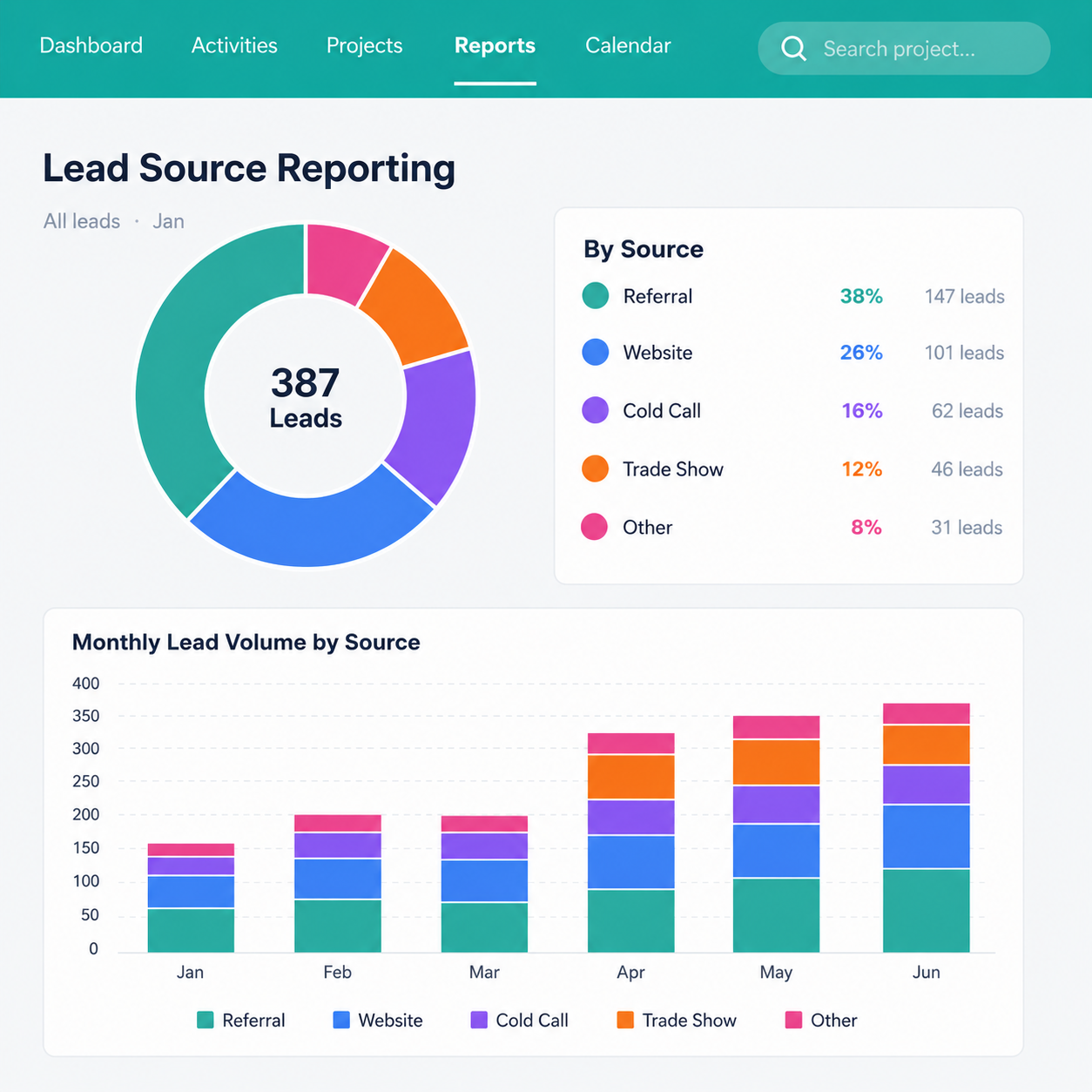
AI in construction is not just for the jobsite. Followup CRM puts it to work where revenue actually starts: your sales pipeline.
Gregg AI Assist drafts your follow-up emails, task updates, and project summaries in seconds, in the tone you choose, so no lead sits cold while a message waits to be written.
Voice AI goes further. Walk off a site visit, say what happened, and the AI handles the data entry into your pipeline for you. No typing, no forgotten updates, no bids slipping through cracks.
Behind it all, real-time dashboards show exactly where every bid stands and which follow-ups win work.
This is the same AI advantage covered in every example above, applied to the part of your business that pays for all the rest. Followup CRM is built by contractors and trusted by more than 1,100 construction professionals.
Book a demo call today and see what AI-powered follow-up does to your close rate.
FAQs About AI in Construction Examples
How do you use artificial intelligence in construction?
Start with one problem, then match AI solutions to it. Contractors use artificial intelligence in construction for estimating and takeoffs, scheduling, safety monitoring, quality control, and construction project management. The office is often the easiest entry point.
Followup CRM lets sales teams put AI to work immediately, drafting follow-ups with Gregg AI Assist and logging site notes by voice with Voice AI, so integrating AI can start paying off before it ever reaches the jobsite.
What is the best AI to use for construction companies?
It depends on which part of the job you want to improve. Scheduling platforms fit complex project planning, and site cameras fit progress monitoring.
For winning work, Followup CRM is the strongest fit for commercial contractors, combining lead and bid tracking with Gregg AI Assist for writing and Voice AI for hands-free data entry, all in a CRM built by contractors.
What is the 30% rule in AI?
The 30% rule is a guideline saying people should stay responsible for roughly 30% of any AI-assisted task, the part requiring judgment, context, and final review, while AI handles the repetitive 70%.
Followup CRM is built around the same principle. Gregg AI Assist generates the draft, but the user always reviews, edits, and sends the final message.
The CRM Built For Construction Companies
No more disorganized data. Track your leads, bids, and customers all in one place.
Seamless Integration with:
✅ Foundation ✅ Viewpoint ✅ Sage and more