


TL;DR
- Lead generation, qualification, estimating, bid submission, follow-up, and closing form the backbone of every construction sale.
- A clear go/no-go decision keeps your estimators focused on projects you can actually win.
- Most bids are not lost on price. They are lost to silence after submission.
- Contractors that stay on GCs' preferred bidder lists spend less time chasing cold leads.
- A reliable construction CRM tool like Followup CRM turns your pipeline, bid deadlines, and follow-ups into one system your whole team can see.
What Is the Construction Sales Process?
The construction sales process is the series of steps a contractor follows to turn a potential customer into a signed contract.
It typically runs from lead generation and qualification through estimating, bid submission, follow-up, and closing. Each stage has a clear purpose and a clear owner, so nothing depends on one person remembering to act.
Construction sales differ from most industries in a few important ways. The sales cycle is long, often stretching over months from first contact to award. Deals involve multiple decision-makers, from project owners and general contractors to architects and procurement teams.
And every sale is tied to a specific project with its own scope, timeline, and budget, which means no two deals move at the same pace.
That complexity is exactly why a defined process matters. Construction sales teams that work from a documented process know which stage every deal sits in, what happens next, and when to step in before an opportunity goes cold.
The different stages of the construction sales cycle serve separate purposes, but consistent recordkeeping plays a key role in connecting them. The client relationship, project fit, timing, price, and available capacity are key factors at several points in the process.
Teams that wing it end up with bids scattered among spreadsheets, inboxes, and sticky notes, and deals slip through the gaps between them.
Key Stages of the Construction Sales Process
Construction sales processes include a similar set of core stages, whether you are a general contractor pursuing commercial construction projects or a specialty sub bidding to a GC.
Here is how each stage works and what it takes to run it well.
1. Lead Generation and Prospecting
Lead generation is where the pipeline starts. For commercial contractors, the strongest sources are rarely cold.
They come from relationships with general contractors who send bid invitations, plan rooms and bid boards that list upcoming construction projects, referrals from past clients, and repeat work from owners who already know your crews.
A construction company does not need more leads from every available source. It needs qualified opportunities that match its services, capacity, and target market and can lead to more jobs.
Prospecting still has a place. A phone call to a GC you want to work with, a visit to an industry event, or outreach to property managers planning capital projects can all open doors that bid boards never will.
The goal is a steady flow of new leads so your pipeline never depends on a single source.
Whatever the source, every new lead should land in one place, with the contact, project type, and lead source recorded from the first touch. That record is what makes every later stage possible.
If leads arrive by email, voicemail, and word of mouth and never get logged, your team is not managing a pipeline. It is reacting to whatever surfaced most recently.
2. Lead Qualification
Not every lead deserves an estimate. Qualifying leads early is what separates disciplined construction sales teams from busy ones.
Every hour your estimators spend on a poor-fit project is an hour taken from stronger opportunities.
This is the go/no-go decision, and it works best as a short checklist your team applies to every new lead.
- Is the project funded?
- Does the scope match your capabilities and capacity?
- Is the timeline realistic for your backlog?
- Is there decent profit potential?
- Do you have a relationship with the GC or owner, and is it a good one?
- Does the project match your geographic area?
Some construction businesses score each factor and set a threshold. Others just require a quick huddle before any estimate starts.
Either way, the output is the same: a smaller list of qualified leads that your team pursues with full effort, instead of a long list of maybes that gets shallow effort everywhere.
Record the no-go decisions too. A project that fails qualification today may fit next year, and the reasoning saves you from re-running the same debate when the same GC sends the next invitation.
3. Estimating and Takeoff
Once a lead clears qualification, the project moves to estimating. The takeoff lists the materials and labor the job requires, and the estimate turns that list into a price that covers your costs and protects your margin.
Accurate estimates matter to the sales process for two reasons. The obvious one is winning: a number that is too high loses the bid, and one that is too low wins a job that costs you money. The less obvious one is speed.
Bid deadlines are fixed, and an estimating team that gets clean project information from sales, without chasing missing details, submits on time without last-minute scrambles.
That handoff is where sales and estimating either work as one team or grind against each other. The lead record built during qualification, with scope, contacts, site details, and documents in one place, is what the estimating team should inherit.
When estimators start from real-time data instead of a forwarded email thread, the estimate comes back faster, and the salesperson can spend those days preparing the proposal instead of relaying questions.
4. Proposal and Bid Submission
The proposal is where months of work turn into a document the client can green-light. For most commercial construction bids, that means responding to the owner's or GC's requirements completely, in the order they asked, by the deadline. A strong bid that arrives late is a lost bid.
A good proposal does more than state a price. It shows the client you understood the project: the scope, the schedule, the site conditions, and the concerns they raised during earlier conversations.
Sales reps who listened well in the qualification stage write proposals that read like answers, not templates.
Consistency helps here. Branded proposal templates keep quality steady when your team submits more bids in a busy season, and they cut the production time on each one.
Once the bid goes out, log the submission date, update the deal's stage in your pipeline, and notify the team.
The proposal leaving your office is not the end of the sale. It is the start of the stage where most deals are actually won or lost.
5. Follow-Up and Negotiation
Follow-up is the stage most contractors handle worst, and it is where the most winnable deals die. A bid goes out, the team moves to the next estimate, and the proposal sits in a GC's inbox with six others. When nobody calls, the contractor who does call sets the conversation.
A reliable follow-up process is simple: every submitted bid gets a scheduled next step. Check in a few days after submission to confirm the proposal arrived and ask whether any questions came up.
Keep notes from every touch, because the details a client shares after the initial contact often reveal what actually decides the award.
This stage is also where negotiation happens. Scope clarifications, value engineering requests, and schedule adjustments are all signals the client is serious.
Treat them as progress, respond quickly, and document what changes. Clear client communication through this stretch builds the confidence that turns a shortlisted bid into a win.
None of this requires talent so much as consistency. This is the stage Followup CRM was built around: reminders tied to every open bid, so no proposal goes quiet because someone forgot.
6. Closing and Handoff to Production
Closing in construction is rarely a single dramatic moment. It is the steady confirmation of details that ends with a signed contract: final scope, price, schedule, payment terms, insurance, and bonding requirements.
Assign an owner and target date to each outstanding item. Deals lose momentum when paperwork stalls, and a client left waiting starts hearing from your competitors again.
Once the contract is signed, the sale is not finished until production has everything it needs.
A clean handoff transfers the full project record: contacts, documents, estimate details, commitments made during negotiation, and any promises the client will remember even if your team forgets.
Project managers who inherit complete records deliver what sales sold, which protects the relationship the whole process was built to create.
Close the loop internally too. Log the win, record what worked, and when you lose, ask why. Contractors who track win and loss reasons over time learn which project types, GCs, and bid strategies produce successful outcomes, and their pipelines get smarter every quarter.
Common Challenges in Construction Sales
Construction sales come with unique challenges that generic sales advice does not account for. Knowing them is the first step to building a process that holds up under real conditions.
The construction sales cycle is long. Months can pass between first contact and award, and priorities shift while you wait. Funding falls through, projects get delayed, and the contact who championed your bid changes companies.
A long cycle punishes teams that rely on memory, because nobody accurately remembers a conversation from four months ago.
Decisions involve many stakeholders. Owners, GCs, architects, and procurement teams all influence the award, and each cares about something different. A bid that wins over the estimator can still stall with the owner.
Sales runs on borrowed time. In many construction businesses, the people selling are also running projects. Construction business owners often carry the pipeline themselves, and follow-up is the first thing dropped when a job site demands attention.
Visibility is poor. When bids live in spreadsheets and inboxes, nobody can say what is in the pipeline, which bids are due, or why last quarter's win rate dropped. You cannot improve sales performance you cannot see. The next section covers what fixes that.
How to Improve Your Construction Sales Process
A documented process is the starting point. What separates the best construction sales teams is how consistently they run it and how quickly they spot where it leaks.
The four improvements below deliver the most gains for the effort, and the right tools make each one easier to sustain.
Track Every Bid in One Place
The single biggest upgrade for most contractors is moving the pipeline out of spreadsheets and into construction CRM software.
When every lead, bid, and deadline lives in one system, your team can see the full pipeline at a glance, and nothing gets lost between an estimator's inbox and a salesperson's notebook.
Followup CRM was built for exactly this. Leads import from any source, each one tracks through the pipeline with its documents and contacts attached, and a digital bid calendar keeps every due date visible to the whole team.
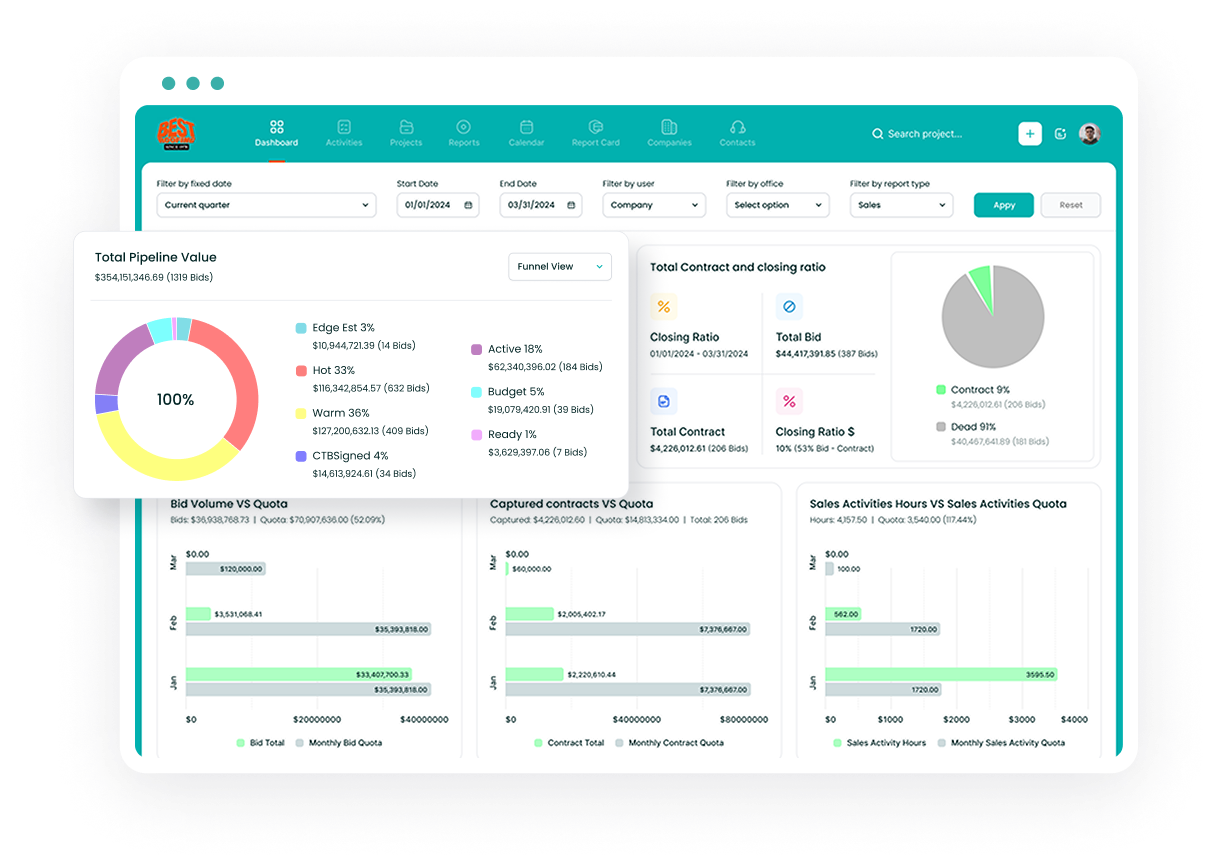
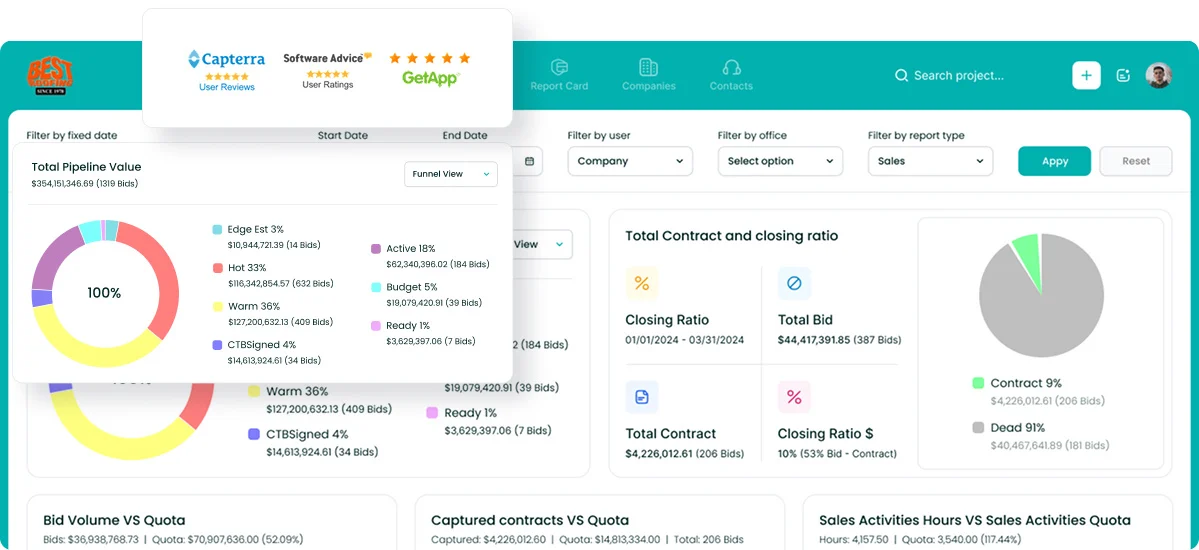
Dashboards show pipeline value, close rates, and team activity in real time, so leadership reviews take minutes instead of a morning of chasing numbers.
For contractors used to hunting through spreadsheets, having every bid a few clicks away is a genuine game changer for staying organized.
Standardize Your Follow-Up Process
Follow-up should not depend on anyone's memory or spare time. Decide the cadence once, then make it automatic: a check-in call within days of submission, a scheduled touch every week or two after, and a clear owner for every open bid.
Notifications and reminders tied to the pipeline handle the remembering for you. In Followup CRM, every open opportunity carries its next step, and the system flags bids that have gone quiet before they go cold.
Teams that standardize this stage routinely win more deals from the same number of bids, because they are present for the tiebreakers their competitors sleep through.
Invest in Sales Training and Techniques
Construction expertise does not automatically make someone good at selling construction services. Many construction sales reps came up through the field or the estimating desk, and they carry deep project knowledge but little formal sales training.
Closing that gap pays off quickly. Train your team on the sales techniques that matter most in this industry: asking the questions that surface a client's real concerns, presenting a bid as a solution instead of a number, and handling price objections without immediately cutting margin.
Role-play the conversations that decide awards. Even a modest, consistent training habit lifts win rates, because most competitors invest nothing in it at all.
The benefits of regular sales training go beyond individual skills. A shared approach helps the team define success, handle objections consistently, and learn from both won and lost bids.
Build Long-Term Relationships for Repeat Business
The cheapest lead is the client you already have. Securing repeat business from owners and staying on general contractors' preferred bidder lists means a pipeline that partially fills itself, and negotiated work that never goes to open bid.
Relationship building is a process, not a personality trait. Deliver what you sold, communicate during the project, and stay in touch after closeout instead of disappearing until the next bid invitation.
Contractors who treat every completed construction job as the first step of the next sale spend less on generating leads, and their business growth compounds, because generating revenue from long-term relationships costs a fraction of winning cold work.
No Bid Slips By With Followup CRM
If bids in your company still live in spreadsheets, follow-up depends on whoever remembers, and nobody can say what the pipeline is worth this quarter. The problem is not effort. It is the system.
Your team is likely already bidding enough work. A process with gaps just lets too much of it slip away quietly, one unanswered proposal at a time.
Followup CRM gives commercial contractors a single place to run the entire sales process. Leads come in from any source and land in one pipeline. The digital bid calendar keeps every deadline in front of the team.
Reminders attach a next step to every open opportunity, so follow-up happens on schedule instead of when things calm down. Proposals go out branded and consistent, with e-signature built in.
And dashboards show close rates, pipeline value, and team performance without anyone building a report.
More than 1,000 construction professionals use Followup CRM to track their bids and win more of them.
FAQs About Construction Sales Process
What are the seven steps in the sales process?
The classic seven steps are prospecting, preparation, approach, presentation, handling objections, closing, and follow-up.
In construction, these map onto a bid-driven flow: lead generation, qualification, estimating, proposal, negotiation, closing, and post-submission follow-up. A CRM keeps each deal visible at every step, so none of them gets skipped.
What are the seven steps of construction?
A typical project runs through planning and design, pre-construction, procurement, site preparation, construction, commissioning, and closeout.
The sales process ends where this one begins, which is why a clean handoff matters: a CRM that transfers contacts, documents, and commitments to production protects everything the sale promised.
What is the 30-60-90 rule in sales?
It is a plan that structures a new sales rep's first three months: learn the company, product, and pipeline in the first 30 days, start working leads and building relationships by day 60, and carry full sales responsibility by day 90.
Construction sales teams onboard reps faster when the pipeline lives in a CRM, because the entire bid history is there to learn from.
What do construction sales consist of?
Construction sales consist of generating and qualifying leads, estimating project costs, submitting bids and proposals, following up through negotiation, and closing contracts.
The work centers on winning projects rather than selling products, which is why contractors use a construction-specific CRM to track bids, deadlines, and follow-ups in one place.
The CRM Built For Construction Companies
No more disorganized data. Track your leads, bids, and customers all in one place.
Seamless Integration with:
✅ Foundation ✅ Viewpoint ✅ Sage and more