The Real Cost of Letting Leads Slip Through the Cracks
Most construction sales teams are working hard. They're juggling site visits, building relationships with general contractors, and trying to keep up with a steady stream of incoming bid invitations. The work isn't the issue. The issue is what happens between the work.
When a follow-up isn't scheduled, it doesn't happen. When a proposal goes out without a clear next touchpoint, it sits in a prospect's inbox. When an estimator finishes a site visit and forgets to flag the next step, the lead cools off. None of these are dramatic failures. They're quiet ones. And quiet failures are the most expensive kind, because you never notice them until it's too late to fix them.
The painful truth is that most lost deals weren't lost on price or scope. They were lost on silence. The contractor who followed up one more time won the job. The estimator who responded within a day got the next bid invitation. The team that stayed top of mind closed the deal. As your pipeline grows, the problem only compounds, which is why a simple framework for tracking construction bids becomes essential rather than optional.
If you can't tell me, right now, what your top three open opportunities are and when each one is being touched next, you have a follow-up problem. And you're not alone.
Why You Don't Know What Your Team Is Actually Doing
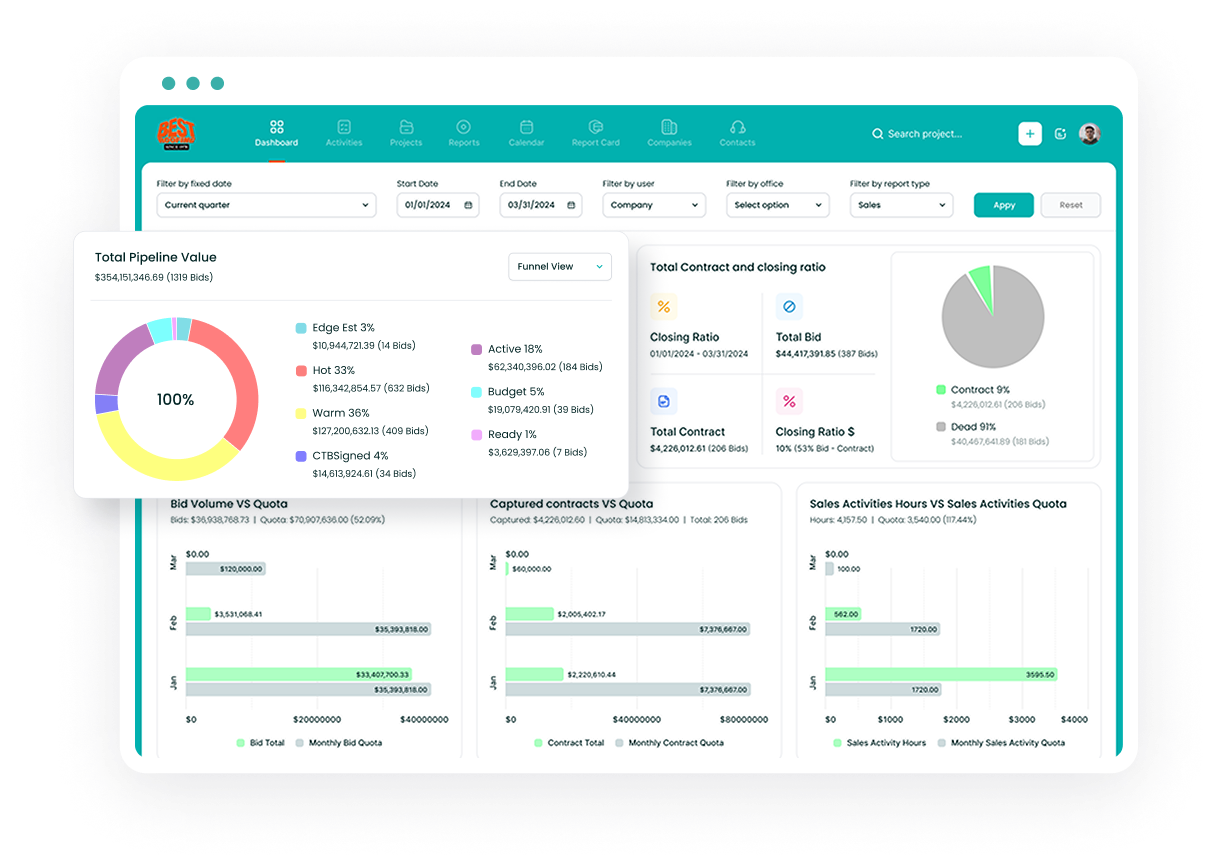
Walk into most construction offices and ask the owner or sales manager a simple question: how many estimates went out last week? How many follow-ups happened on bids over $100K? Which deals are at risk of going cold this month? Most can't answer with confidence. They can give you a feeling, a rough estimate, or a story about one or two deals. But not a number.
That isn't because they don't care. It's because the information isn't anywhere they can see it. It's scattered across spreadsheets, sticky notes, individual inboxes, and a few key people's heads. When one of those people takes a vacation or leaves the company, a chunk of your business walks out the door with them. It's also why pipeline forecasting has become such a priority for construction sales teams that want to plan further than a week ahead.
This is the part that keeps owners up at night. You've built a business that depends on a handful of people remembering things. You don't have a system. You have a workaround. And workarounds break under pressure.
Accountability Without Pressure
There's a common fear among owners and sales managers when they think about introducing more structure: that it will feel like micromanagement. That the team will push back. That tracking activities will be seen as a vote of no confidence.
In practice, the opposite is true. When salespeople and estimators have a clear system for what's expected of them, accountability becomes easier, not harder. Top performers actually want this. They want credit for the work they're doing. They want a record of the calls they made, the proposals they delivered, and the deals they advanced. Vague accountability protects underperformers and frustrates your best people. Clear accountability rewards the right behavior, which is one of the biggest reasons sales leaders consistently choose a purpose-built CRM to win more construction work.
What good accountability looks like is simple. Every active opportunity has a next step with a date attached. Every team member knows what's on their plate today, this week, and this month. Every manager can see, at a glance, where the bottlenecks are and who needs help. Nobody is guessing. Nobody is digging through old emails to reconstruct what happened. The system holds the memory so your people don't have to.
Visibility Changes Everything
When you can see your team's pipeline activity in real time, several things start to happen.
You stop being surprised. Deals don't go cold without a warning sign. You can spot the project that hasn't been touched in two weeks and ask a useful question before it's too late. You shift from reacting to deals you've already lost to coaching your team on deals you can still win.
You start making better decisions about capacity. When you can see how many active opportunities each estimator is carrying, you can balance the load before someone burns out or starts dropping the ball. You can spot the rep who's quietly carrying twice as much as everyone else and the one who suddenly has bandwidth for a new account. This is the kind of shift that comes from transforming construction data into smarter sales decisions instead of guessing.
You build a business that doesn't depend on memory. The work becomes transferable. When a new estimator joins, they can pick up an existing project without needing a long conversation to figure out where things stand. When someone is out sick, deals don't stall. The institutional knowledge lives in the system, not in someone's head.
And maybe most importantly, you give your team the tools to actually do their best work. Most construction salespeople aren't avoiding follow-up. They're drowning in projects and trying to keep track of dozens of moving parts at once. Give them a clear, simple way to manage their day, and they'll use it. Force them to live out of a spreadsheet and a memory, and they'll keep losing deals they should be winning.
Built for the Way Construction Actually Works
Generic CRMs weren't built for the construction sales cycle. They don't understand bid dates, pre-bid meetings, site visits, multi-stakeholder projects, or the long timelines that come with commercial work. They were built for software sales and adapted, awkwardly, for everyone else.
A CRM built specifically for construction sales looks different. It tracks the things you actually care about: estimates due, proposals delivered, site visits scheduled, bid dates approaching. It gives owners and managers visibility into team workload without requiring an MBA to operate. It makes follow-up automatic instead of optional. And it gives your team a real-time picture of what's coming up next, whether they're at their desk, in the truck, or walking a job site.
The companies that grow consistently in this industry aren't the ones with the biggest teams or the cheapest bids. They're the ones with the tightest follow-up. They close more deals from the same number of leads because they actually finish the conversations they start. If you want a closer look at what that discipline looks like in practice, take a look at how high-performing construction sales teams manage their pipeline.
If your gut response is that this sounds like a "nice to have" rather than a priority, it might be worth reading why "it's not in the budget" usually isn't the real issue. For most contractors, the cost of staying disorganized is far higher than the cost of fixing the problem.
Ready to Close the Gap?
If any of this sounds familiar, the best next step is a short conversation. Book a demo and we'll show you exactly how other construction companies are solving it.
The deals you're losing to silence are deals you can win back.




-1.png)